How much of your day actually goes into patient care?
And how much disappears into notes, charts, follow-ups, and documentation?
If you’ve ever finished your last appointment and realized you still have an hour or two of charting left, you already know the problem.
Documentation is necessary. But spending your evening catching up on it shouldn’t feel like part of the job.
That’s where better EHR software can make a real difference.
Documentation is part of the job. It shouldn’t take over the job.
Providers have always had to document patient care.
The problem is that modern practices have more information to manage than ever.
Patient histories. Medications. Lab results. Treatment plans. Follow-ups. Messages. Consent forms. Notes.
And much of it still ends up being entered, organized, reviewed, and updated manually.
According to the American Medical Association, physicians spend an average of 5.8 hours in the EHR for every eight hours of scheduled patient care. The AMA’s analysis included EHR data from more than 200,000 physicians.
That’s a lot of time spent in a system that is supposed to make healthcare easier.
What if your EHR handled more of the busywork?
This is where an AI Powered EHR Platform starts to make sense.
Not because AI should take over clinical decisions.
It shouldn’t.
But there are plenty of repetitive parts of documentation and administration that don’t necessarily need to be done from scratch every single time.
Think about:
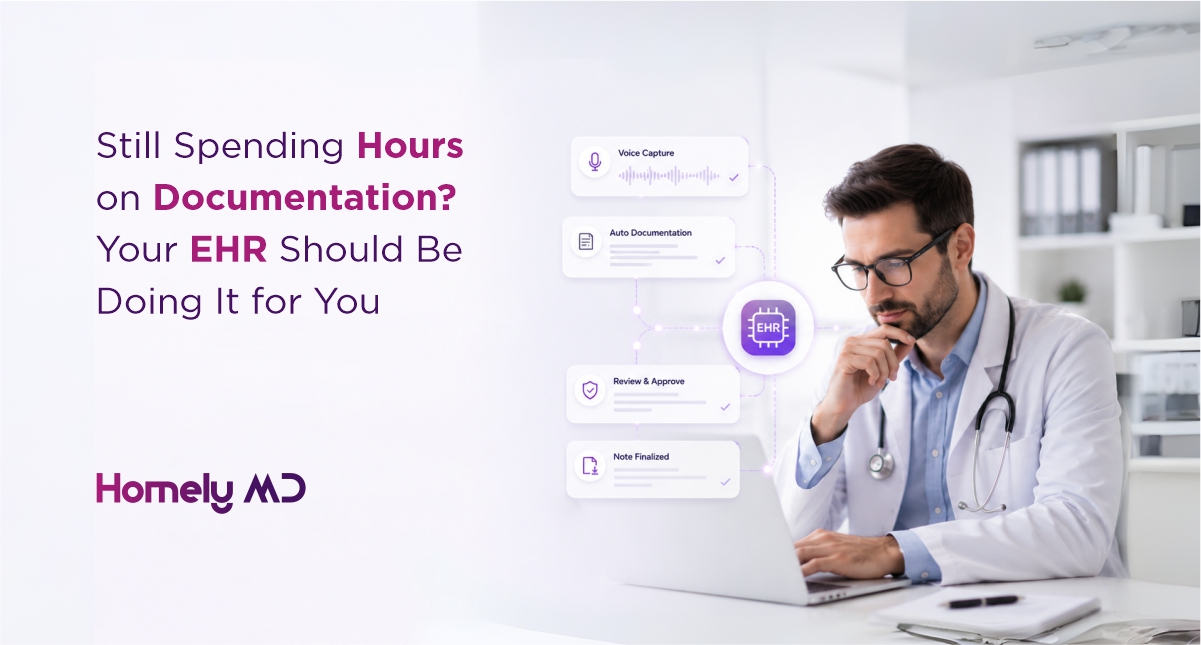
- Turning conversations into structured notes
- Helping organize patient information
- Creating documentation summaries
- Pulling relevant information into one place
- Supporting follow-up tasks
- Reducing duplicate data entry
- Keeping clinical workflows moving
The provider stays in control.
The software simply does more of the groundwork.
Your clinical workflow shouldn’t stop when the appointment ends
A patient’s visit is only one part of the process.
There might be lab results to review.
A treatment plan to update.
A follow-up to schedule.
A patient message to answer.
Another note waiting to be completed.
When these things live in disconnected systems, your team ends up spending time moving information around instead of actually using it.
A connected clinical workflow can make that process much smoother.
The information follows the patient instead of getting stuck in different places.
AI is most useful when it solves boring problems
This might not sound as exciting as the usual AI conversation.
But honestly, that’s the point.
The best use of AI in an EHR may not be something dramatic.
It might be helping a provider finish documentation faster.
It might be summarizing a long conversation.
It might be making a patient’s information easier to review.
It might be helping staff keep track of what needs to happen next.
Those small improvements add up when you’re doing them dozens of times a day.
What should you look for in EHR software?
If you’re considering a new EHR software solution, don’t just ask how many features it has.
Ask what it actually takes off your plate.
Does it reduce repetitive documentation?
If your team still has to enter the same information in multiple places, something isn’t really being streamlined.
Does it support your actual workflow?
Your software should fit the way your practice operates, not force your team into a completely different process.
Can it connect clinical information?
Patient records, labs, notes, appointments, and follow-ups should be easy to access when they’re relevant.
Does the AI assist rather than take over?
Clinical AI should support providers and make information easier to work with. It shouldn’t pretend to replace clinical judgment.
Can your practice grow with it?
The system that works for five providers should ideally not become a headache when you have 20.
A little less documentation can mean a lot more time
Imagine finishing your last appointment and not immediately thinking about the charts waiting for you.
Imagine your staff spending less time checking whether something was entered correctly.
Imagine opening a patient record and actually finding what you need without clicking through several different systems.
That’s what good technology should feel like.
Not impressive.
Just easier.
How Homely MD approaches documentation
Homely MD‘s AI Powered EHR Platform is designed to connect clinical documentation with the rest of the healthcare workflow.
The platform brings together EHR, AI-assisted documentation, patient records, lab workflows, scheduling, telehealth, communication, billing, and practice management.
The goal isn’t to add more technology to your day.
It’s to remove some of the work that technology has traditionally created.
For providers, that can mean spending less time documenting and more time with patients.
For staff, it can mean fewer repetitive tasks to chase.
And for the practice as a whole, it can mean a clinical workflow that actually feels connected.
Because your EHR should help you finish the work.
It shouldn’t be the reason you’re still working after everyone else has gone home.
Get in touch!
FAQs
Can AI really reduce documentation time?
It can help with tasks such as generating summaries, organizing information, and supporting documentation. The amount of time saved depends on the workflow and how the system is used.
Will AI write my clinical notes for me?
Some AI-enabled systems can assist with note creation, but providers should review and approve documentation rather than blindly relying on generated content.
Is an AI-powered EHR only useful for large practices?
No. Smaller practices can benefit too, especially when the same small administrative tasks are repeated throughout the day.
What makes an EHR platform useful?
It should make everyday work easier, keep patient information organized, support your clinical workflow, and reduce unnecessary manual work.
Does automation replace healthcare staff?
No. Good healthcare automation should handle repetitive tasks while allowing staff and providers to spend more time on work that requires human judgment and interaction.