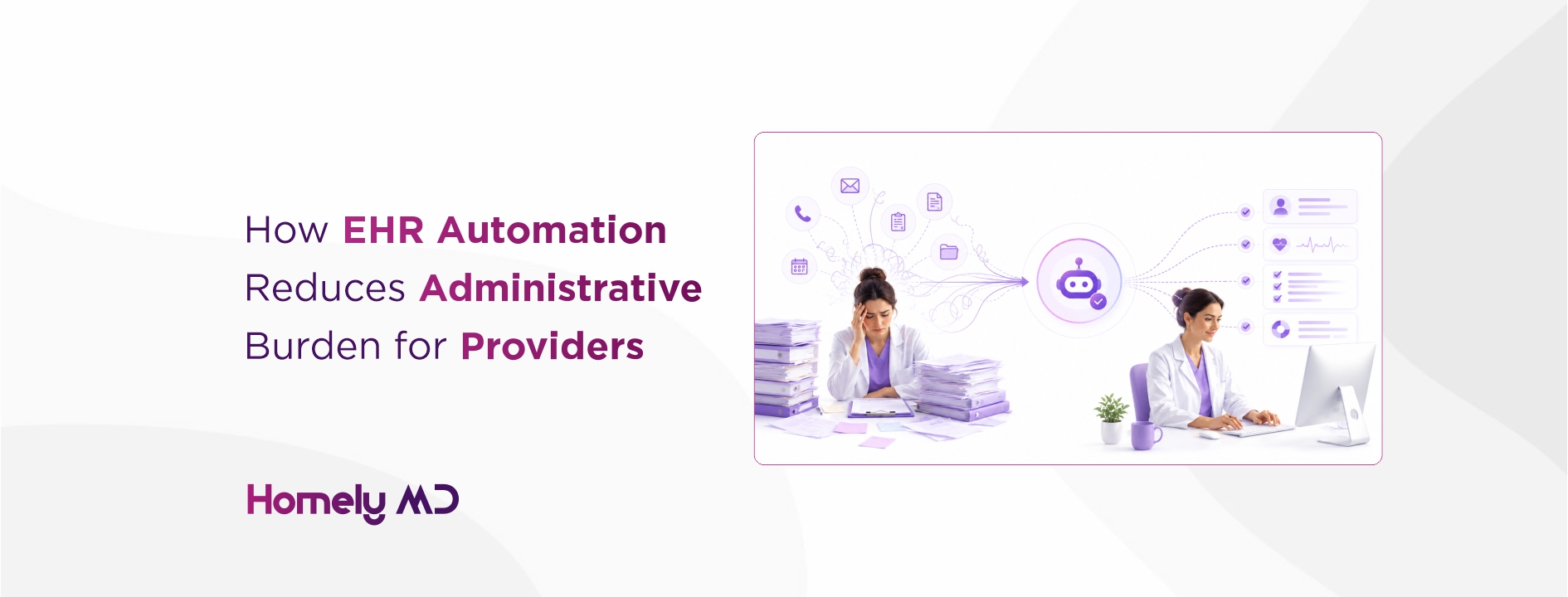
If you’ve ever spoken to a healthcare provider after clinic hours, you’ve probably heard the same thing.
“The appointments are over, but my work isn’t.”
Charts still need to be completed.
Lab results need reviewing.
Messages are waiting.
Refills need approval.
Follow-ups need scheduling.
By the time everything is done, it’s well past the end of the workday.
For many providers, it’s not patient care that’s causing burnout.
It’s everything that happens around it.
That’s exactly why EHR Automation has become such an important conversation in healthcare.
Because when administrative work starts taking over clinical time, everyone loses, including patients.
The paperwork didn’t disappear. It just became digital.
Years ago, healthcare relied on filing cabinets and paper charts.
Today, most practices have digital records.
But digital doesn’t always mean efficient.
Many providers still switch between multiple systems to document visits, review labs, manage prescriptions, schedule appointments, and communicate with patients.
The paperwork may have moved to a screen, but the workload often hasn’t changed.
In some practices, it has actually grown.
Administrative work is contributing to burnout
According to the American Medical Association’s Organizational Biopsy® survey, 57.8% of physicians reported at least one symptom of burnout in 2023, with administrative burden and documentation requirements continuing to rank among the biggest contributors.
That statistic highlights something many providers already know.
Burnout isn’t always about seeing too many patients.
Sometimes it’s about spending hours behind a computer after the patients have gone home.
Automation isn’t about replacing providers
Whenever people hear the word automation, they often think about replacing people.
That’s not what healthcare needs.
Providers should be making clinical decisions.
Technology should be handling repetitive administrative tasks.
That’s where Healthcare Workflow Automation makes a real difference.
Instead of manually moving information between systems, providers can spend more time focusing on patient care while routine workflows happen more efficiently in the background.
Small tasks quickly become a full day’s work
Think about everything that happens during a normal clinic day.
Appointments need to be confirmed.
Patients complete intake forms.
Clinical notes need documentation.
Lab orders are placed.
Results come back.
Follow-up reminders are sent.
Prescriptions are reviewed.
Invoices are generated.
None of these tasks takes very long individually.
Together, they consume hours every single week.
That’s why improving workflows isn’t just about saving time.
It’s about reducing unnecessary mental load.
Better workflows create better patient experiences
Patients may never ask what EHR platform you use.
But they notice when things run smoothly.
Appointments start on time.
Information doesn’t have to be repeated.
Results are communicated promptly.
Follow-ups don’t get forgotten.
Behind almost every seamless patient experience is a team supported by efficient systems.
That’s one of the biggest benefits of Healthcare Administrative Burden Reduction.
When staff spend less time chasing paperwork, they have more time for people.
Growth becomes much easier
Many healthcare businesses reach a point where growth starts creating operational problems.
More providers.
More locations.
More patients.
More documentation.
Without the right systems, every new patient adds more administrative work.
With EHR Automation, many routine processes can scale alongside the business instead of relying on manual effort.
That means practices can grow without creating unnecessary operational bottlenecks.
Automation helps the whole team
This isn’t only about physicians.
Receptionists spend less time tracking appointments.
Practice managers gain better visibility into operations.
Clinical staff spend less time searching for information.
Patients receive a more consistent experience.
Good automation improves communication across the entire practice, not just documentation.
The goal isn’t more technology
Ironically, many practices already have too much software.
One platform for scheduling.
Another for documentation.
Another for patient communication.
Another for CRM.
Another for billing.
Instead of simplifying work, disconnected systems often create more work.
The goal isn’t adding more technology.
It’s making existing workflows feel connected.
That’s where an integrated approach to Healthcare Workflow Automation becomes valuable.
Healthcare should feel more human, not more administrative
Nobody chooses a career in healthcare because they love paperwork.
Providers want to diagnose, treat, educate, and help people.
Technology should support that mission, not compete with it.
At Homely MD, our EHR platform is designed to reduce administrative complexity by bringing documentation, scheduling, lab workflows, pharmacy integration, CRM, AI-assisted notes, compliance, and patient management together in one connected ecosystem.
Get in touch with Homely MD to discover how EHR Automation and Healthcare Workflow Automation can help reduce administrative burden, improve efficiency, and give your team more time to focus on patient care.
FAQs
Is EHR automation only useful for large healthcare organizations?
Not at all. Smaller practices often feel the impact even more because teams are leaner and staff usually wear multiple hats.
Does automation mean less interaction with patients?
Quite the opposite. When repetitive administrative tasks take less time, providers often have more time to focus on meaningful patient interactions.
What kinds of tasks can be automated?
Depending on the platform, automation can support appointment scheduling, patient reminders, documentation workflows, lab coordination, follow-ups, billing processes, and more.
Will automation replace my existing team?
The goal isn’t to replace people. It’s to reduce repetitive work so your team can spend more time on higher-value tasks that require human judgment and care.
How do I know if my practice needs better workflow automation?
If your team is constantly switching between systems, manually entering the same information, or staying late to finish administrative work, it’s probably worth reviewing whether your current workflows are supporting your growth or slowing it down.