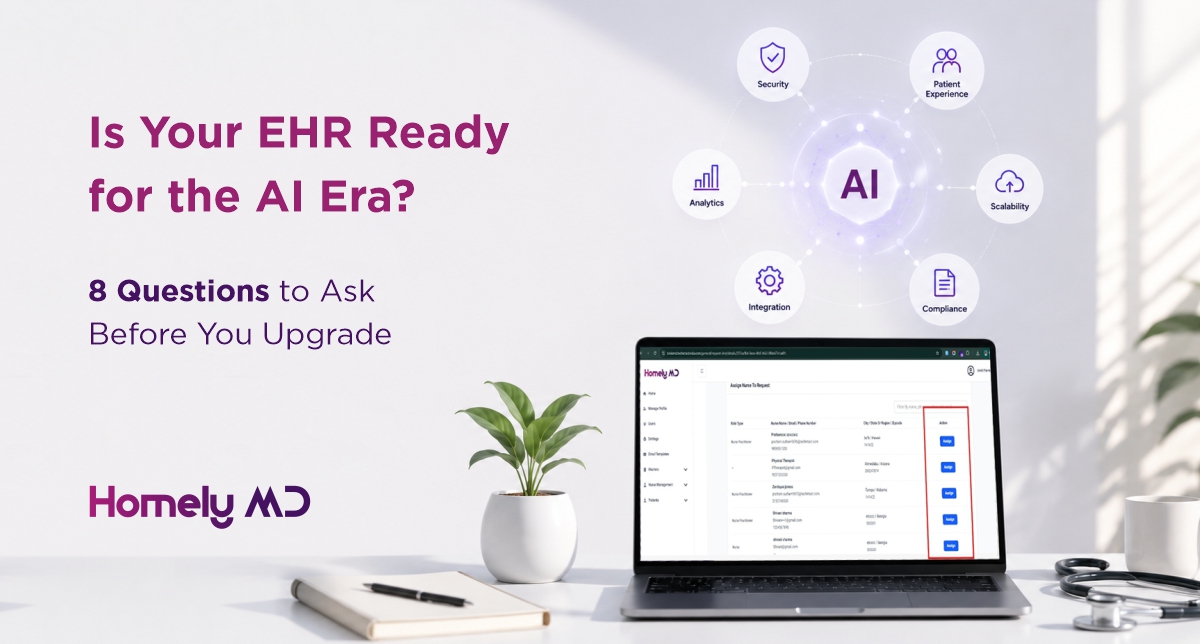
Let’s be honest. Almost every healthcare technology company is talking about AI right now.
AI documentation. AI summaries. AI insights. AI automation.
So, if you’re already thinking about upgrading your EHR system, it’s easy to assume that choosing one with AI is automatically the right move.
But not every AI feature is actually useful.
And more importantly, not every practice needs AI just for the sake of having AI.
The better question is: Will this actually make your team’s day easier?
Before upgrading your EHR software, here are eight questions worth asking.
1. Does the AI actually save my team time?
This should probably be the first question.
An AI-powered EHR can sound impressive on a sales page, but what does it actually do once your team starts using it every day?
Can it help reduce documentation time?
Can it summarize information?
Can it help organize patient data?
Can it automate repetitive follow-ups or administrative tasks?
If the answer is simply, “It has AI,” ask more questions.
Technology should solve a real problem.
According to the American Medical Association, physicians spend an average of 5.8 hours in the EHR for every eight hours of scheduled patient care. That makes time-saving technology particularly relevant, but only if it genuinely reduces work rather than adding another tool to learn.
2. Does it fit into our existing workflow?
A new EHR system shouldn’t force your entire team to completely change how they work overnight.
Every practice has its own rhythm.
Your front desk works differently from your clinical team. Your providers have their own documentation preferences. Your billing and administrative workflows have their own processes too.
Before upgrading, ask whether the platform can support the way your practice actually operates.
Because even the smartest EHR software becomes frustrating if it creates more steps instead of removing them.
3. What exactly is the AI helping with?
“AI-powered” is a broad term.
One platform may use AI for documentation. Another may use it to summarize calls. Another may help organize lab information or automate workflows.
Those are very different things.
So ask directly:
What does the AI actually do?
You should know where AI is being used and how it supports your team before making a decision.
The answer should be specific.
4. Will it reduce duplicate work?
Few things are more frustrating than entering the same patient information in multiple places.
A patient books through one platform.
Their information has to be entered into another.
The provider documents somewhere else.
Billing happens in another system.
That isn’t really an efficient workflow.
A good AI-powered EHR should ideally help connect information and reduce unnecessary manual work.
Before upgrading, look at how many times your team currently enters, copies, or searches for the same information.
That will tell you a lot about what your next system needs to fix.
5. Can the AI support my team without replacing their judgment?
This one matters.
AI can help organize information and support repetitive tasks, but healthcare still requires human judgment.
Providers should remain responsible for clinical decisions and review information generated or summarized by AI.
The goal isn’t to hand over decision-making.
It’s to reduce some of the administrative work surrounding care.
Think of it as support, not replacement.
6. Does the system connect the entire patient journey?
An appointment is only one part of a patient’s experience.
There may be a lead before the appointment.
Digital intake before the consultation.
Documentation during the visit.
Labs or treatment plans afterward.
Follow-ups.
Payments.
Recurring programs.
Future appointments.
When all of those stages sit in different systems, your team ends up doing a lot of manual work just to keep everything connected.
Before upgrading your EHR system, ask how well it supports the entire patient journey, not just what happens during the appointment.
7. Is my data secure and easy to manage?
AI capabilities are exciting, but security should still be one of the practical questions you ask.
Find out:
- Who can access patient information?
- Does the system offer role-based permissions?
- How is data protected?
- What happens to your existing data when you migrate?
- How difficult is it to move your records into the new platform?
A good upgrade shouldn’t leave your team wondering where important patient information went.
The transition matters just as much as the new features.
8. Will this system still work for us as we grow?
Maybe your practice is small today.
But what happens when you add more providers?
Another location?
Telehealth?
New services?
Recurring memberships?
Your technology should not become the thing holding you back every time the business grows.
A modern EHR software should be able to support your practice as its needs become more complex.
Because switching systems every few years isn’t exactly anyone’s idea of fun.
A quick checklist before you upgrade
Before choosing a new AI-powered EHR, ask yourself:
☐ Does it solve an actual problem for my practice?
☐ Will it reduce repetitive work?
☐ Does it support our current workflow?
☐ Do we understand exactly what the AI does?
☐ Can providers review and stay in control of AI-supported work?
☐ Does it connect different parts of the patient journey?
☐ Does it offer the security and access controls we need?
☐ Can it grow with our practice?
If you’re struggling to answer several of these questions, it might be worth slowing down before signing up.
AI should make your EHR feel less like work
The AI era doesn’t necessarily mean every practice needs to completely reinvent how it operates.
Sometimes, the biggest improvement is much simpler.
Less time documenting.
Less duplicate information.
Fewer disconnected systems.
Easier access to what you need.
A smoother day for your team.
That’s what an AI-powered EHR should really be helping with.
How Homely MD approaches the AI era
At Homely MD, we believe AI should be useful in the places where healthcare teams actually feel the workload.
Our EHR software is designed to bring together patient records, AI-assisted documentation, lab workflows, telehealth, scheduling, communication, billing, reporting, and practice operations in one connected environment.
The goal isn’t to add AI because it’s the latest trend.
It’s to help providers and healthcare teams spend less time dealing with disconnected workflows and more time focusing on patients.
Because before upgrading your EHR system, there is one final question worth asking:
Will this actually make our day easier?
If the answer is yes, then you’re probably looking in the right direction.
Get in touch!
FAQs
What is an AI-powered EHR?
An AI-powered EHR uses artificial intelligence to support tasks such as documentation, summaries, workflow automation, and organizing information, depending on the platform.
Do I need to replace my current EHR to use AI?
Not always. Some systems add AI capabilities to existing platforms, while others are built with AI features as part of the overall system.
Can AI make clinical decisions for providers?
AI can support workflows and organize information, but clinical decisions should remain with qualified healthcare professionals.
What should I check before upgrading EHR software?
Look at your current workflow first. Identify what is taking your team the most time, then see whether the new system genuinely solves those problems.
Is an AI-powered EHR only useful for large practices?
No. Smaller practices can benefit too, especially when a small team is spending significant time on repetitive administrative work.