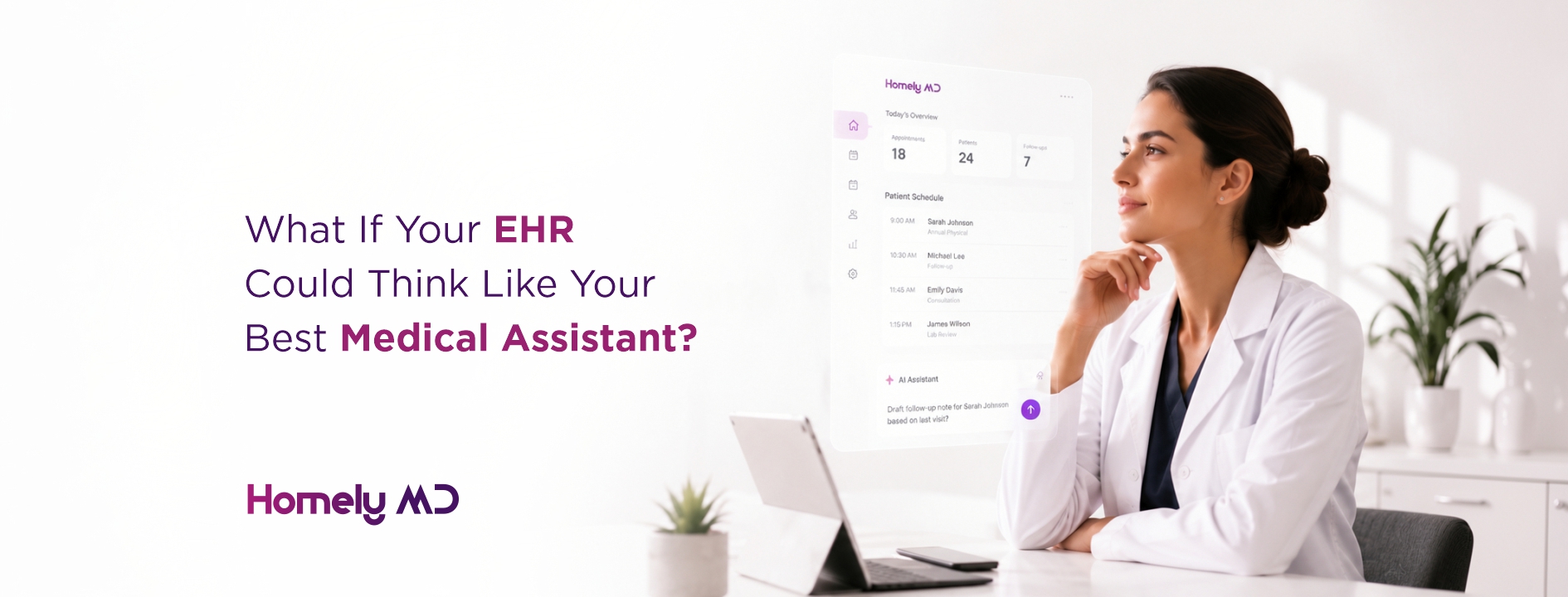
What if your EHR could do some of the things your best medical assistant does every day?
Remind you that a patient still hasn’t completed their intake.
Keep track of what needs to happen after an appointment.
Help organize information before you sit down with a patient.
Make documentation a little less painful.
Not replace your medical assistant. Just take some of the repetitive work off their plate.
That is where modern EHR software is starting to become more interesting.
Your medical assistant does a lot more than you think
Think about a normal day in a busy practice.
Patients need to be checked in. Forms need to be collected. Appointments need to be managed. Messages need responses. Records need updating. Follow-ups need to happen.
And then there are all the little things nobody really notices until they don’t get done.
A missing form.
A reminder that wasn’t sent.
A lab result that needs reviewing.
A patient who needs to be called back.
Your team handles all of it.
But they shouldn’t have to handle every single task manually.
The EHR workload is bigger than most people realize
According to the American Medical Association, ambulatory physicians spend an average of 5.8 hours in the EHR for every eight hours of scheduled patient care. Researchers analyzed EHR activity from more than 200,000 physicians across 396 organizations.
That’s a lot of time looking at a screen.
And not all of that time is spent on actual patient care.
Documentation, chart review, orders, inbox messages and other EHR tasks can spill beyond scheduled clinical hours too. The AMA’s research found that physicians spent an additional 1.3 hours on unscheduled days working in the EHR, on average.
So when we talk about making an EHR “smarter,” the real question isn’t how impressive the technology sounds.
It’s much simpler:
Can it take some work off the team’s hands?
What if your EHR could handle the little things?
This is where healthcare automation becomes useful.
Imagine your system helping with things like:
- Appointment reminders
- Digital patient intake
- Follow-up tasks
- Documentation support
- Patient communication
- Lab workflows
- Recurring appointments
- Billing workflows
- Internal notifications
Your team still makes the decisions.
They still speak to patients.
They still provide the human side of care.
The software simply handles more of the predictable stuff in the background.
And honestly, that’s probably where automation makes the most sense.
It’s not really about “AI”
AI is everywhere in healthcare right now.
But most providers aren’t sitting at their desk thinking:
“I need more AI.”
They’re thinking:
“Why am I still doing this manually?”
That’s the better question.
If software can save your team from entering the same information twice, sending the same reminder 40 times, or spending an hour catching up on documentation, that’s useful.
You don’t need a flashy feature.
You need fewer things on your to-do list.
A quick reality check
How many of these happen in your practice?
☐ Staff manually send appointment reminders.
☐ Patients regularly forget to complete intake forms.
☐ Someone has to chase missing information.
☐ Providers finish documentation after hours.
☐ Follow-up tasks are tracked through notes, spreadsheets, or memory.
☐ Your team jumps between multiple systems throughout the day.
☐ The same patient information gets entered more than once.
If you checked several boxes, your team may not need to work harder.
Your EHR software may simply need to do more.
Your medical assistant shouldn’t have to remember everything
Good medical assistants are incredibly good at keeping things moving.
But they’re still human.
They can miss a reminder.
Something can get buried in an inbox.
A follow-up can slip through when the clinic gets busy.
That’s not a criticism of the team. It’s what happens when people are expected to keep track of too many small tasks at once.
A good EHR platform can act as another layer of support.
It can keep information organized, trigger certain workflows, surface tasks, and help the team know what needs attention.
The person stays in control.
The system helps them stay on top of things.
The goal is fewer clicks, not more technology
This part matters.
A healthcare platform can have hundreds of features and still make your day harder.
The Office of the National Coordinator for Health Information Technology (ONC) says EHRs can automate and streamline provider workflows, improve the organization of patient information, and reduce administrative burden.
That’s the kind of technology worth paying attention to.
Not technology that gives your team another dashboard to check.
Technology that quietly removes steps from the work they’re already doing.
What should a modern EHR platform actually do?
Before choosing an EHR platform, forget the giant feature list for a minute.
Ask practical questions.
Does it save my team time?
Can it reduce repetitive data entry?
Can it help with documentation?
Can it keep patient information connected?
Can it automate routine follow-ups?
Does it support both virtual and in-person care?
Can my staff actually figure out how to use it without a week of training?
That last one matters more than people think.
The best software is the software your team actually uses.
The human side still matters most
There is a reason people trust good medical assistants.
They notice things.
They remember patients.
They pick up the phone when someone is confused.
They know when something feels off.
Automation can’t replace that.
And it shouldn’t try to.
If software can handle a reminder, your team can spend time making a patient call that actually needs a person.
If documentation becomes easier, providers can spend less of their evening catching up.
If information is organized, staff don’t have to spend their morning searching for it.
The technology handles the repetitive stuff. Your people handle the human stuff.
That feels like a much better use of both.
How Homely MD approaches EHR software
At Homely MD, we don’t think an EHR platform should just sit there storing patient records.
It should actually help your practice run.
Homely MD brings together EHR software, scheduling, telehealth, AI-assisted documentation, patient communication, billing, lab workflows, reporting, and practice management in one connected environment.
The idea is pretty straightforward.
Give providers and their teams fewer repetitive things to worry about.
Let the system handle more of the predictable work.
And give people more time to focus on patients.
Maybe your EHR doesn’t need to think like your best medical assistant
It just needs to make your medical assistant’s job easier.
That’s really the promise of healthcare automation.
Not replacing people.
Not making healthcare feel robotic.
Not adding another complicated system to your day.
Just taking some of the busywork out of healthcare so your team can spend more time doing the things that actually require them.
Because the best technology doesn’t make your practice feel more automated.
It makes your practice feel less busy.
Get in touch!
FAQs
Can an EHR really save my team time?
It can, especially when it reduces repetitive tasks like manual reminders, duplicate data entry, documentation, and follow-ups. The actual time saved depends on the system and how your practice uses it.
Is an AI-powered EHR going to replace my medical assistant?
No. Automation is better suited to repetitive, predictable tasks. Your staff still handle communication, coordination, patient questions, and the human side of care.
What does healthcare automation actually automate?
It depends on the platform, but it can include reminders, intake, documentation support, follow-up tasks, patient communication, scheduling, billing workflows, and internal notifications.
Is an EHR platform useful for a small practice?
Absolutely. Smaller teams often have fewer people available to handle administrative work, so removing repetitive tasks can make a noticeable difference.
What should I look for when choosing EHR software?
Don’t just look at how many features it has. Look at whether it is easy to use, reduces repetitive work, connects your workflows, supports your team’s actual needs, and can grow with your practice.
What makes Homely MD different?
Homely MD brings clinical and business workflows together, including EHR, telehealth, scheduling, AI-assisted documentation, patient communication, billing, lab workflows, reporting, and practice management.
The goal is to give healthcare teams one connected environment instead of making them piece everything together themselves.