Ask any healthcare provider what takes up most of their day.
It probably won’t be patient care.
It’ll be logging into different systems.
One for appointments.
Another for patient records.
A different one for billing.
Something else for telehealth.
Then there’s the lab portal, the CRM, the phone system, and whatever spreadsheet someone made three years ago that everyone is still using.
Individually, none of these tools seem like a problem.
Together, they create one.
That’s why more providers are looking beyond standalone software and investing in an healthcare technology platform instead.
The problem isn’t technology. It’s too much of it.
Healthcare has become more digital over the last decade.
That’s a good thing.
But somewhere along the way, practices started solving every new challenge by adding another platform.
Need online scheduling?
Buy a scheduler.
Need telehealth solutions?
Add another subscription.
Need billing?
There’s another tool for that.
Need patient communication?
One more login.
Before long, your team is spending as much time switching between systems as they are helping patients.
That’s not efficiency.
It’s operational overload.
Growth shouldn’t make your practice harder to run
Things usually work fine when there’s one provider and a small patient list.
But growth changes everything.
A second provider joins.
Telehealth launches.
Patient numbers increase.
You open another location.
Suddenly, information is scattered across multiple platforms, and staff are constantly asking each other where something was saved.
The issue isn’t that the practice is growing.
The issue is that the systems weren’t built to grow with it.
According to the numbers, complexity is one of healthcare’s biggest challenges
A 2024 Bain & Company survey found that more than 80% of healthcare executives believe simplifying operations and improving efficiency are among their highest priorities as organizations continue adopting digital technologies.
That reflects what providers experience every day.
Technology should make work easier.
Not create another layer of administration.
One patient. One journey.
Think about what happens when a new patient books an appointment.
They complete forms.
Schedule a consultation.
Receive reminders.
Meet with the provider.
Complete lab work.
Review results.
Receive a treatment plan.
Make payments.
Book follow-ups.
None of these steps should feel disconnected.
An integrated healthcare platform keeps that journey together instead of forcing providers and staff to jump between multiple systems every step of the way.
Better systems create better patient experiences
Patients don’t know what software you’re using.
They don’t care.
What they notice is whether everything feels connected.
They appreciate not having to repeat their medical history.
They like receiving appointment reminders on time.
They expect providers to have access to their records.
They notice when follow-ups happen without them chasing the clinic.
Behind almost every smooth patient experience is good infrastructure.
It’s not just about clinical care anymore
An integrated EHR/EMR system can help providers manage patient information while connecting clinical workflows with the broader healthcare platform.
They manage memberships.
Coordinate labs.
Run telehealth appointments.
Track inventory.
Handle recurring payments.
Communicate with patients.
Measure business performance.
Support multiple providers.
If every one of those tasks happens in a different platform, the business becomes harder to manage with every new patient.
That’s where Healthcare Infrastructure becomes a competitive advantage instead of just an operational necessity.
The best software is the one you barely notice
Good technology shouldn’t demand attention.
It should quietly remove friction.
The receptionist shouldn’t have to copy information into three systems.
Providers shouldn’t finish documentation hours after the clinic closes.
Owners shouldn’t wait until the end of the month to understand how the business is performing.
An integrated platform helps every part of the practice work together instead of independently.
Healthcare is becoming more connected
Patients today expect flexibility.
They want virtual care when it makes sense.
In-person care when they need it.
Simple communication.
Faster follow-ups.
Healthcare providers deserve systems that support those expectations without creating more work behind the scenes.
That’s exactly why integrated healthcare platforms are becoming the foundation of modern practices.
Your software should grow with your business
Adding another provider shouldn’t mean adding three more software subscriptions.
Opening another location shouldn’t require rebuilding your workflows from scratch.
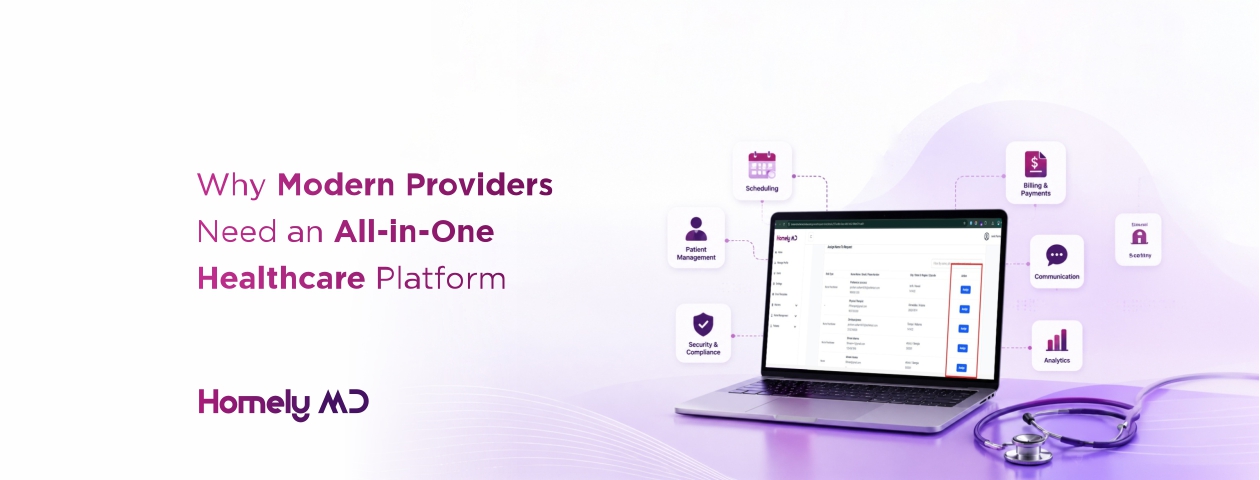
The right technology shouldn’t give you more systems to manage. It should quietly make your day easier. When your scheduling, patient records, billing, telehealth, and communication all work together, your team spends less time chasing information and more time looking after patients. That’s exactly what we’ve built at Homely MD.
If you’re ready to spend less time managing software and more time growing your practice, get in touch with Homely MD to see how our all-in-one healthcare platform can support the way you work today and the business you’re building for tomorrow.
FAQs
My current software works. Why would I switch?
If your team is constantly moving between platforms, manually updating information, or relying on spreadsheets to connect systems, it may be working, but probably not efficiently.
Is an all-in-one platform only for large healthcare organizations?
Not at all. Smaller practices often benefit the most because lean teams have less time to manage multiple systems and repetitive administrative work.
Can an integrated platform help improve patient experience?
Absolutely. When scheduling, records, communication, billing, and follow-ups are connected, patients typically experience fewer delays, less repetition, and smoother care.
What should I look for in a healthcare platform?
Beyond core clinical features, look for a platform that supports scheduling, communication, billing, reporting, telehealth, and future growth without forcing your team to juggle multiple disconnected tools.
Is this about replacing people with technology?
Not at all. The goal is to reduce repetitive administrative work so providers and staff can spend more time doing what matters most, caring for patients.