A lot of healthcare providers dream about running their own practice.
Very few dream about commercial leases.
Or plumbing issues.
Or waiting six months for construction to finish.
Yet that’s often where the journey begins.
You spend years studying medicine, treating patients, and building experience, only to realise that starting your own practice has very little to do with healthcare and a lot to do with real estate.
That’s changing.
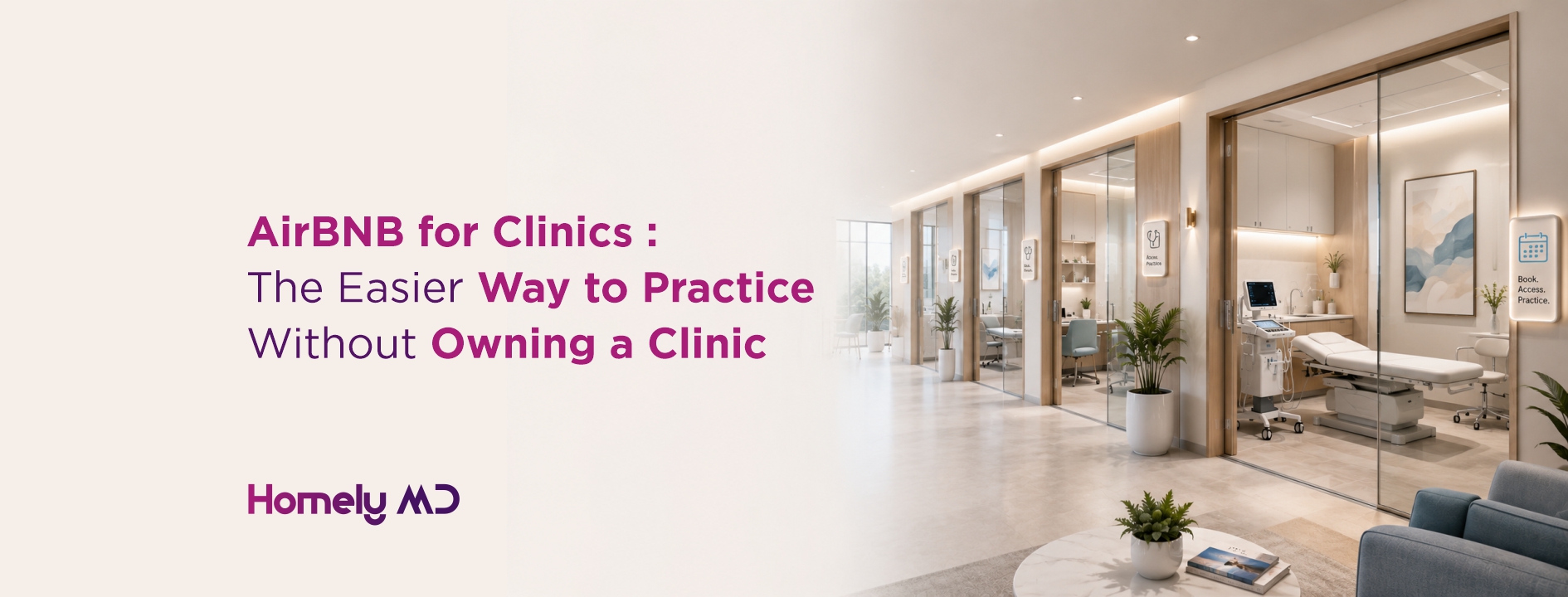
The rise of the AirBNB for Clinics model is giving providers another way to grow, one that feels lighter, faster, and far less intimidating.
The clinic isn’t always the business
For years, healthcare and real estate have gone hand in hand.
If you wanted to build a practice, you needed your own location.
- Your own lease.
- Your own reception.
- Your own treatment rooms.
- That model worked when healthcare looked different.
- Today, providers move differently.
Many split their time between telehealth and in-person care.
Some travel across cities.
Others offer wellness, longevity, injections, or weight management services that don’t require an entire facility sitting empty all week.
According to CBRE’s 2025 Healthcare Real Estate Outlook, outpatient visits in the U.S. increased from 1.8 visits per patient in 2000 to 2.4 visits per patient in 2022.
The report also notes that nearly 80% of new medical office buildings are now being developed away from traditional hospital campuses, reflecting a broader shift toward smaller, more flexible healthcare spaces that bring care closer to patients.
Owning a clinic is no longer the only path.
Sometimes, it’s not even the smartest one.
Most providers don’t need more space
They need better access.
There’s a difference.
A nurse practitioner offering hormone optimization may only need a treatment room twice a week.
A physician launching a longevity practice may want to test a new market before signing a lease.
A telehealth brand may need somewhere professional for lab draws or injections.
In all of these situations, healthcare workspace on demand makes more sense than permanent infrastructure.
The goal isn’t to own more square footage.
The goal is to see more patients.
The startup costs add up quickly
Anyone who has opened a clinic knows the feeling.
The excitement lasts until the invoices arrive.
- Rent.
- Construction.
- Medical equipment.
- Insurance.
- Utilities.
- Staffing.
- Compliance.
By the time the clinic is ready, months have passed, and the investment keeps growing.
It’s one reason so many talented providers delay launching their own business.
The financial commitment feels bigger than the opportunity.
Flexible infrastructure changes that equation.
Build the patient base first
One thing healthcare can learn from other industries is the importance of testing demand.
Restaurants don’t always open five locations overnight.
Retail brands launch pop-ups before expanding.
Fitness studios often start small before growing into multiple branches.
Healthcare has traditionally done the opposite.
Providers commit first and validate later.
The AirBNB for Clinics model flips that thinking.
Instead of investing heavily upfront, providers can establish a local presence, understand patient demand, and expand when the numbers actually make sense.
That feels like smarter business.
Growth doesn’t always look like another clinic
Sometimes growth means offering a new service.
Sometimes it means entering another city one day a week.
Sometimes, it simply means giving patients more convenient access.
That’s why scalable clinic rental solutions for providers are becoming part of the conversation.
They allow businesses to grow gradually instead of taking one enormous financial leap.
For many providers, that flexibility creates opportunities that traditional clinic ownership simply doesn’t.
The freedom to focus on healthcare
Ask most clinicians what they enjoy about their work.
You’ll hear about patient relationships.
Treatment outcomes.
Making a difference.
You probably won’t hear anyone say they enjoy negotiating commercial leases.
Infrastructure should support healthcare, not distract from it.
Having access to healthcare workspace on demand allows providers to spend more time growing their practice and less time worrying about buildings.
That’s a trade-off many are happy to make.
A different way of thinking about practice ownership
Owning a clinic will always make sense for some providers.
But it doesn’t have to be the default starting point anymore.
Healthcare is becoming more flexible.
Patients expect convenience.
Providers expect flexibility.
The spaces where care happens should evolve too.
That’s why the AirBNB for Clinics model is gaining momentum.
It gives providers room to grow without forcing them to carry unnecessary overhead before they’re ready.
Sometimes the best way to build a practice isn’t by buying more space.
It’s by accessing the right space at the right time.
At Homely MD, we’re building a nationwide network of treatment rooms that gives providers the freedom to launch, expand, and scale without the traditional barriers of clinic ownership.
Get in touch to discover how AirBNB for Clinics, scalable clinic rental solutions for providers, and healthcare workspace on demand can help you build the practice you’ve always wanted.
FAQs
Do I need to own a clinic to build a successful practice?
Not anymore. Many providers are choosing flexible treatment spaces that allow them to grow without taking on major infrastructure costs upfront.
Who benefits most from healthcare workspace on demand?
Nurse practitioners, physicians, wellness providers, telehealth brands, and specialists looking for flexibility often find it a practical option.
Is this only for new businesses?
No. Established practices also use flexible spaces to test new markets or introduce additional services without opening another permanent clinic.
Why are scalable clinic rental solutions becoming more popular?
They give providers the ability to expand at their own pace while keeping overhead lower and reducing financial risk.
Does using shared treatment space affect patient experience?
In most cases, patients care about receiving great care in a professional environment. How the space is owned is rarely their concern.