There comes a point in almost every provider’s journey where the same thought pops up.
Maybe it’s time to start my own practice.
It’s exciting for about five minutes.
Then reality shows up.
Commercial leases.
Construction quotes.
Medical equipment.
Furniture.
Insurance.
Compliance.
Utilities.
Staff salaries.
Suddenly, the dream isn’t about helping more patients anymore. It’s about finding another six figures just to unlock the front door.
That’s the part nobody talks about.
For many providers, the biggest obstacle isn’t building a patient base.
It’s paying for an empty clinic before a single appointment is booked.
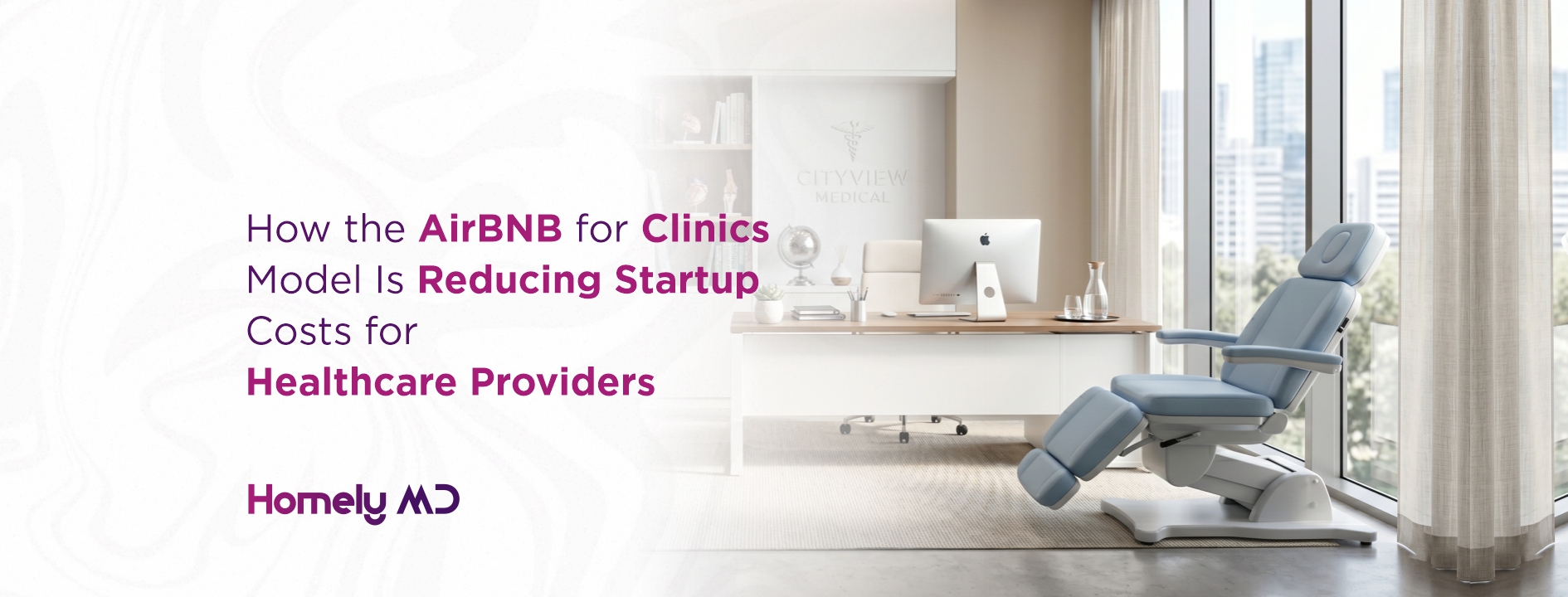
That’s exactly why more people are paying attention to the AirBNB for Clinics model.
Not because it’s cheaper.
Because it makes growth feel possible again.
The old way of expanding feels risky
A physician wants to launch a longevity practice.
A nurse practitioner wants to offer weight management services.
A telehealth brand wants to start seeing patients in person.
The first question shouldn’t be:
Can I afford a five-year lease?
It should be:
Is there enough demand to justify opening here?
Traditional healthcare rarely allows providers to answer the question first.
Instead, they’re expected to commit to expensive infrastructure and hope everything works out later.
For many businesses, that’s simply too much risk.
Interestingly, the industry itself is moving in a different direction. According to CBRE’s 2025 U.S. Healthcare Real Estate Outlook, nearly 80% of new medical outpatient buildings are now being developed away from traditional hospital campuses and closer to where people live and work.
The shift reflects a growing preference for more accessible, flexible care models that allow providers to expand without relying on large, infrastructure-heavy facilities.
Sometimes you don’t need another clinic
You just need a room.
That sounds obvious, but it’s changing how providers think about expansion.
Not every practice needs a 3,000-square-foot facility.
Some providers need one treatment room twice a week.
Others need somewhere to see patients while they build awareness in a new city.
Some simply need a professional environment for injections, consultations, or wellness treatments.
That’s where On demand Clinic Space is changing the conversation.
Instead of paying for unused square footage, providers can access the space they actually need.
Nothing more.
Nothing less.
The smartest businesses usually test first
Think about restaurants.
Retail brands.
Fitness studios.
Most validate demand before opening multiple locations.
Healthcare has traditionally done the opposite.
Sign the lease.
Renovate the clinic.
Hire the staff.
Then hope patients come.
The AirBNB for Clinics model flips that thinking.
Providers can establish a local presence, build trust within the community, and understand patient demand before making long-term infrastructure decisions.
It feels less like gambling and more like building a business.
Startup costs quietly stop good ideas from happening
There are plenty of talented providers who never launch their own practice.
Not because they lack experience.
Not because they lack patients.
Because startup costs feel overwhelming.
The financial pressure alone is enough to keep many clinicians employed instead of entrepreneurial.
Access to clinic space rental removes one of the biggest barriers between having an idea and actually acting on it.
Sometimes that’s all someone needs.
A place to start.
The freedom to grow differently
Owning a building isn’t the same as growing a business.
Modern healthcare looks different now.
Telehealth is normal.
Hybrid care is growing.
Wellness brands are expanding across multiple cities.
Providers want flexibility because their patients expect flexibility too.
Having access to on demand clinic space gives practices room to adapt without carrying unnecessary overhead every month.
That’s becoming a competitive advantage.
It’s not just about saving money
The interesting thing is that most providers aren’t looking for the cheapest option.
They’re looking for the smartest one.
They want to spend their budget on hiring better staff, improving patient experience, investing in technology, or expanding services.
Not paying rent on treatment rooms sitting empty three days a week.
That’s why flexible infrastructure is becoming part of the conversation.
It allows providers to focus on healthcare instead of real estate.
Healthcare is slowly catching up
Other industries embraced flexibility years ago.
People work from coworking spaces.
Businesses use shared offices.
Retail brands test pop-up stores before committing to permanent locations.
Healthcare is finally beginning to move in the same direction.
Moreover, honestly, it makes sense.
Not every provider needs another clinic.
Some just need access.
At Homely MD, we’re building a nationwide network of treatment rooms designed to help providers launch, grow, and scale without the traditional barriers that often slow healthcare businesses down.
Get in touch with Homely MD to discover how flexible clinic space rental solutions can support the next stage of your practice.
FAQs
I’m just starting out. Is flexible clinic space actually enough?
For many providers, yes. It’s often a practical way to start seeing patients before taking on the cost of a permanent clinic.
Who usually uses On demand Clinic Space?
It’s a mix of physicians, nurse practitioners, wellness providers, telehealth brands, and specialists who want flexibility while they grow.
Does renting clinic space make a business look less established?
Patients usually care about the experience and quality of care, not whether the treatment room is owned or rented.
Why are more providers interested in the AirBNB for Clinics model?
Because it lowers financial risk and gives providers more freedom to expand at their own pace instead of making huge commitments upfront.
Is this only useful for startups?
Not at all. Established practices use flexible clinic spaces too, especially when testing new markets or adding new services without opening another permanent location.