Table of Contents
For many healthcare providers, running a practice involves more than seeing patients. They must also consider workspace costs, appointment schedules, equipment, staffing, and the practical demands of maintaining a clinical location.
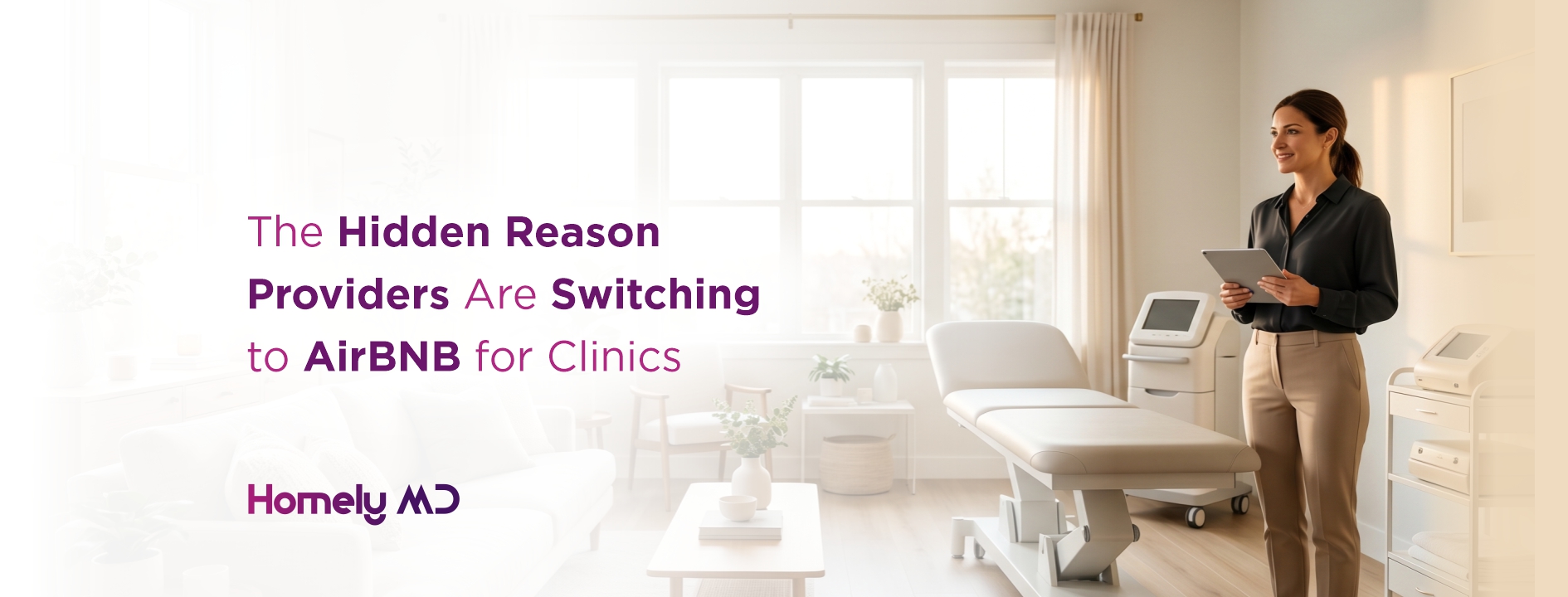
These responsibilities can become challenging when patient appointments are concentrated on only a few days each week. That is one reason some providers are exploring the Airbnb for clinics model as an alternative to relying exclusively on a permanent medical office.
The Challenge Is Matching Clinic Costs to Patient Demand
A traditional clinic may involve recurring expenses regardless of how many appointments take place. Rent, utilities, maintenance, and other operating costs can continue during quieter periods.
For an independent provider or a practice entering a new market, these commitments deserve careful consideration.
Flexible clinic arrangements offer another option: access to appropriate space based on a provider’s schedule and business requirements. The actual cost advantage depends on booking rates, availability, contractual terms, and the services being delivered.
Three Reasons Providers Consider Flexible Clinic Access
1. They want more control over their schedules
Some clinicians work across several locations or combine virtual consultations with in-person appointments. Access to clinic space on selected days may better suit these arrangements than maintaining a dedicated office.
2. They want to evaluate a new market
Before committing to a long-term lease, a provider may want to assess whether a particular neighborhood generates enough patient demand. Access to a suitable room can provide a way to test an in-person service offering before making a larger infrastructure commitment.
3. They want to focus on delivering care
Managing premises can take time away from patient communication, service development, and practice administration. Depending on the arrangement, shared clinic space may reduce some facility-management responsibilities.
Providers should still assess who handles cleaning, equipment maintenance, scheduling, security, and other operational duties.
What Providers Should Compare Before Switching
Choosing flexible medical office rental is not simply a matter of comparing hourly rates with monthly rent.
Providers should evaluate:
- Total room costs, including deposits and additional fees.
- Access to the facility during required appointment hours.
- Availability of appropriate clinical equipment.
- Privacy, sanitation, and patient-safety arrangements.
- Insurance, credentialing, and contractual responsibilities.
- Whether the space is appropriate for the intended clinical services.
A permanent clinic may remain the better option for practices with consistent patient volume or specialized facility requirements.
Is Airbnb for Clinics a Better Fit for Independent Providers?
The model may be particularly worth investigating for providers who work part-time at a location, offer selected specialty services, or want to explore a new service area.
Established practices may also consider flexible arrangements when evaluating additional locations. However, providers should compare realistic costs and operational requirements rather than assuming that every flexible arrangement will be less expensive.
How Homely MD Fits Into the Changing Healthcare Landscape
Healthcare delivery increasingly involves different ways of connecting providers, facilities, and patients. Homely MD’s technology-enabled care network incorporates an Airbnb-inspired clinic model in which participating clinics can make available rooms accessible to providers.
The specific services, booking terms, and availability depend on the applicable arrangement. Providers interested in participating should review the relevant requirements before making business decisions.
Ultimately, the reason to consider flexible clinic access is not simply convenience. It is the opportunity to choose a workspace arrangement that aligns with patient demand, operating schedules, and the practical needs of a healthcare business.
For years, the idea of growing a healthcare practice looked almost identical for everyone.
Find a location.
Sign a lease.
Spend months setting it up.
Hope enough patients walk through the door.
Somewhere along the way, that became the accepted formula for success.
The problem is that it doesn’t fit the way healthcare works anymore.
Providers are moving faster. Patients expect convenience. Telehealth has changed expectations, and wellness businesses are expanding into markets they never would have considered a few years ago.
Yet many providers are still expected to commit to a five-year lease before they know whether a new location will even work.
That’s probably the biggest reason interest in the AirBNB for Clinics model keeps growing.
It’s not about avoiding commitment.
It’s about reducing unnecessary risk.
The conversation has quietly changed
According to JLL’s 2025 Medical Outpatient Building Perspective, healthcare providers are increasingly expanding outpatient services while prioritizing operational efficiency and more flexible real estate strategies instead of traditional infrastructure-heavy models. As care continues shifting beyond hospital walls, providers are looking for smarter ways to access clinical space without taking on unnecessary long-term overhead.
Talk to independent providers or founders of wellness brands and you’ll hear the same frustration.
The demand is there.
The patients are there.
The opportunity is there.
What’s missing is affordable infrastructure.
Opening another location sounds exciting until you start calculating the costs. Rent, renovations, equipment, compliance, staffing, utilities, insurance. The list keeps growing before the first patient even books an appointment.
For many businesses, expansion stalls before it even begins.
Not because they lack ambition.
Because the numbers don’t make sense.
Ownership isn’t always the goal anymore
A few years ago, owning a clinic felt like a milestone.
Today, flexibility has become just as valuable.
Many providers don’t need another permanent address.
They need a professional room to treat patients one afternoon a week.
Or somewhere to offer injections while building a local patient base.
Or a treatment room while testing demand in a completely new city.
That’s where flexible clinic space is changing the conversation.
Instead of investing heavily in property, providers can invest in growth.
There’s a big difference.
Growing carefully isn’t the same as thinking small
One mistake people make is assuming flexible models are only for startups.
They’re not.
Established practices are using them too.
Some are launching satellite locations.
Others are adding longevity, weight management, or wellness services without opening another clinic.
Some simply want to see patients closer to where they live.
The common theme isn’t budget.
It’s agility.
Healthcare businesses want room to move without carrying unnecessary overhead.
Test first. Expand later.
This is probably the biggest advantage nobody talks about.
Imagine wanting to expand into another city.
The traditional approach says to lease a property, fit it out, hire staff, and then hope enough patients arrive.
Most industries don’t work like that anymore.
They validate demand first.
Healthcare is finally starting to adopt the same mindset.
Providers can establish a presence, build relationships, and understand local demand before making long-term commitments.
That feels like a much smarter way to grow.
The job is healthcare, not property management
Ask most clinicians what they enjoy about running a practice.
Very few will say commercial leases.
Or maintenance issues.
Or managing empty treatment rooms.
Most simply want to deliver good care and build a sustainable business.
Infrastructure should support that goal, not become another full-time responsibility.
That’s another reason healthcare providers looking for clinic space are exploring more flexible operating models.
Less time worrying about buildings usually means more time focusing on patients.
Healthcare is becoming more adaptable
The industry is changing in small ways that are adding up quickly.
More hybrid care.
More wellness programs.
More concierge services.
More telehealth.
More mobile healthcare.
It makes sense that the physical spaces supporting providers would evolve too.
The future probably won’t belong only to large permanent clinics or tiny private practices.
It will belong to businesses that can adapt quickly as patient needs change.
That’s exactly what flexible infrastructure makes possible.
At Homely MD, we’re building a nationwide network of treatment rooms that gives providers more freedom to launch, expand, and serve patients without the traditional barriers that often slow growth.
Get in touch to discover how AirBNB for Clinics can help your business grow through smarter access to flexible clinic space.
Frequently Asked Questions
Why are healthcare providers considering Airbnb for clinics?
Some providers are exploring flexible clinic arrangements to adapt their workspace access to patient demand and avoid unnecessary long-term commitments.
Can flexible clinic space help reduce medical practice overhead?
It may reduce certain fixed costs, but the financial outcome depends on room rates, utilization, equipment requirements, and other operating expenses.
Is flexible clinic space suitable for established practices?
It can be an option for practices testing new locations or offering services on selected days, provided the space meets their operational and clinical requirements.
What should providers verify before using a shared clinic?
They should review facility suitability, equipment, privacy, cleaning, insurance, credentialing, permitted uses, and contractual responsibilities.