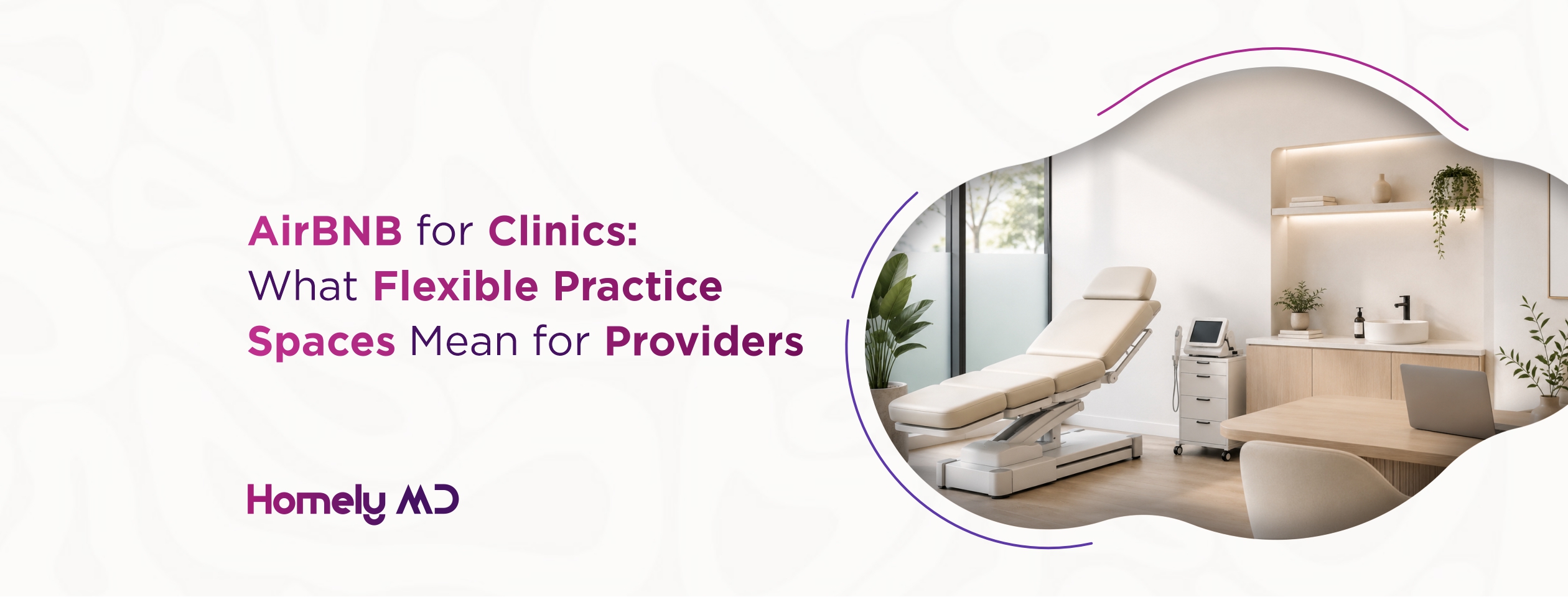
Healthcare providers do not always need a permanent medical office to deliver in-person care. For independent practitioners, nurse practitioners, wellness professionals, and growing medical practices, flexible clinic space can offer an alternative to committing to a full-time facility.
The Airbnb for clinics model applies the idea of flexible access to healthcare workspaces. Instead of maintaining a dedicated clinic that may sit unused for part of the week, providers can explore shared medical office space or book suitable clinical rooms when needed.
What Is Airbnb for Clinics?
Airbnb for clinics describes a flexible approach to accessing physical healthcare spaces. Depending on the provider and facility, this may involve hourly room rentals, scheduled use of treatment rooms, or access to clinical locations for specific days.
The concept connects healthcare professionals who need space with facilities that have available rooms. However, availability, booking arrangements, equipment, and permitted services vary by location.
How Flexible Clinic Space Can Help Providers
1. More adaptable scheduling
Providers who see patients on selected days may benefit from accessing rooms that fit their appointment schedules instead of maintaining a full-time office.
2. Opportunities to serve new locations
A practitioner may want to assess demand in a new neighborhood before establishing a permanent location. Suitable flexible clinic space can provide an opportunity to explore that market.
3. Different options for independent practitioners
Clinicians building a practice may find shared medical office space worth evaluating alongside traditional leases, subleases, and other workspace arrangements.
4. Potentially better use of existing facilities
Clinics with unused rooms may be able to make those spaces available to qualified providers, subject to facility policies, agreements, and applicable regulations.
What Should Providers Check Before Booking?
Not every office or treatment room is appropriate for every healthcare service. Before using an on-demand clinic room, providers should verify the facility’s permitted uses, equipment, privacy arrangements, accessibility, cleaning procedures, and availability.
They should also confirm applicable licensing, credentialing, insurance, documentation, and patient-safety requirements. Services involving medications, procedures, or specialized equipment may require additional safeguards.
Is Flexible Clinic Space Right for Your Practice?
Flexible clinic space may be worth considering if you are starting a practice, serving patients across multiple locations, or exploring a new service line. A traditional clinic may remain more practical when you need dedicated equipment, continuous access, or a highly customized facility.
The best option depends on patient demand, the type of care provided, scheduling requirements, and the total cost of each arrangement.
Homely MD helps healthcare providers explore more flexible ways to participate in a technology-enabled care network. Learn more about Homely MD’s healthcare platform to explore opportunities for building and growing a modern healthcare practice.
Opening a medical practice used to feel very all-or-nothing.
Long leases.
Heavy upfront investments.
Permanent clinic spaces.
Staffing pressure before patient flow even became stable.
For a lot of providers, that model feels difficult now.
Not impossible.
Just unnecessarily rigid.
This is one reason AirBNB for clinics models are getting attention across modern healthcare.
Providers are starting to ask a very different question now:
“What if medical spaces worked more flexibly?”
That shift is changing how many healthcare businesses think about growth, overhead, and scalability.
According to a 2024 report by JLL Healthcare Real Estate, healthcare providers are increasingly exploring flexible practice models to reduce overhead costs, improve operational agility, and expand into new markets without committing to large permanent infrastructure investments.
That shift is one reason AirBNB for clinics and flexible clinic space models are gaining attention now.
A lot of providers want scalability and flexibility without taking on the pressure of maintaining full-time clinic spaces before patient demand fully stabilises.
What Does “AirBNB for Clinics” Actually Mean?
AirBNB for clinics usually refers to flexible clinic space models where healthcare providers can access professional clinical environments without committing to traditional long-term ownership or leases.
Instead of maintaining one permanent clinic full time, providers can use spaces more flexibly depending on schedule, patient demand, or location.
That can include:
- Shared treatment rooms
- Temporary consultation spaces
- On-demand clinic bookings
- Multi-location access
- Flexible scheduling models
Why Traditional Clinic Models Became Stressful for Many Providers
Owning a clinic sounds exciting initially.
But behind the scenes, there is often pressure people outside healthcare never fully see.
Things like:
- High rent
- Equipment expenses
- Staffing costs
- Underused appointment hours
- Operational overhead
And honestly, patient demand is not always perfectly predictable either.
Some weeks are packed.
Others are slower.
But the fixed costs continue regardless.
This is exactly why flexible clinic space models started becoming more appealing.
Why Providers Want More Flexibility Now
Healthcare providers are thinking differently about work now.
Especially newer generations entering healthcare.
A lot of professionals no longer want business models tied entirely to one physical location forever.
Some providers want:
- Part-time practice models
- Multi-city flexibility
- Lower operational pressure
- Easier expansion
- Better work-life balance
This is where things really started changing.
Providers began prioritising flexibility the same way patients already were.
Why AirBNB for Clinics Makes Financial Sense
Traditional clinic setups usually require large upfront commitments.
That can feel risky early on, especially for providers still building consistent patient flow.
AirBNB for clinics creates a much more adaptable structure.
| Traditional Clinic Setup | Flexible Clinic Space |
| Long-term lease commitment | Pay-as-needed access |
| Higher fixed costs | Lower operational pressure |
| One permanent location | Multi-location flexibility |
| Slower expansion | Easier scalability |
| Full-time infrastructure responsibility | Shared operational setup |
For many providers, flexibility itself becomes a business advantage.
Flexible Clinic Space Helps Smaller Practices Grow
This part matters a lot.
Not every provider wants to open a massive clinic immediately.
Sometimes providers simply want space to grow gradually without overwhelming financial pressure early on.
Flexible clinic space models allow providers to:
- Build patient trust first
- Test demand in different locations
- Expand services slowly
- Reduce financial risk
- Operate more strategically
That makes scaling feel much more manageable.
AirBNB for Clinics Is Not Just for New Providers
A lot of established providers are exploring these models too.
Especially when expanding into:
- New neighborhoods
- Wellness services
- Weekend clinics
- Temporary specialty setups
- Additional patient markets
Instead of immediately opening another permanent clinic, providers can test markets more flexibly first.
That operational freedom matters a lot now.
Why This Model Fits Modern Healthcare Better
Healthcare itself is becoming more flexible overall.
You can already see it happening through:
- Telehealth
- Mobile healthcare
- At-home care
- Hybrid healthcare systems
- Digital consultations
So naturally, physical clinic spaces are evolving too.
Healthcare businesses are slowly moving away from rigid infrastructure-heavy systems toward more adaptable models.
Not because traditional clinics are disappearing.
Because flexibility improves sustainability.
What Patients Care About Now
Most patients are not thinking:
“Does this provider own a building?”
They care more about:
- Accessibility
- Convenience
- Communication
- Appointment availability
- Quality of care
That mindset shift changed healthcare business models quietly.
A provider operating through flexible clinic space can still deliver excellent patient experiences.
Sometimes even better ones operationally.
Why Scalability Matters More Than Ever
Provider burnout is very real right now.
Operational pressure is growing.
Healthcare demand is growing.
Costs are growing too.
This is why scalable systems matter much more than before.
AirBNB for clinics models give providers more room to adapt without overcommitting too early.
That flexibility can reduce both financial pressure and operational exhaustion.
The Emotional Side of Flexibility
A lot of providers entered healthcare to help people.
Not necessarily to manage endless operational stress.
Flexible clinic space models can help providers focus more on patients instead of constantly managing infrastructure-heavy business pressure.
That emotional relief matters too.
Especially in modern healthcare, where burnout rates continue rising.
Final Thoughts
Healthcare businesses are entering a much more flexible era.
AirBNB for clinics and flexible clinic space models are helping providers rethink how medical practices can grow without unnecessary operational pressure.
The focus is slowly shifting from heavy infrastructure toward smarter, more adaptable systems.
And honestly, many providers are realizinga flexibility can actually improve sustainability long term.
At Homely MD, healthcare innovation is approached through scalable, modern solutions designed around how providers and patients operate today.
Get in touch with Homely MD to explore smarter healthcare solutions built for modern practice growth.
Frequently Asked Questions
What does Airbnb for clinics mean?
It describes flexible access to healthcare workspace, such as treatment rooms or medical office space, rather than relying exclusively on a permanent, full-time clinic.
Who can benefit from flexible clinic space?
Eligible independent practitioners, specialists, and healthcare businesses may benefit when their schedules or expansion plans do not require a dedicated location every day.
Is shared medical office space suitable for every service?
No. Providers must verify that the facility, equipment, privacy measures, and permitted uses meet the requirements of their specific services.
How should providers compare flexible clinic space with a traditional lease?
Compare total costs, room availability, equipment, location, contractual obligations, and operational requirements before deciding which arrangement fits the practice.