You click the appointment link.
The provider joins.
You talk for 20 minutes.
Then the call ends.
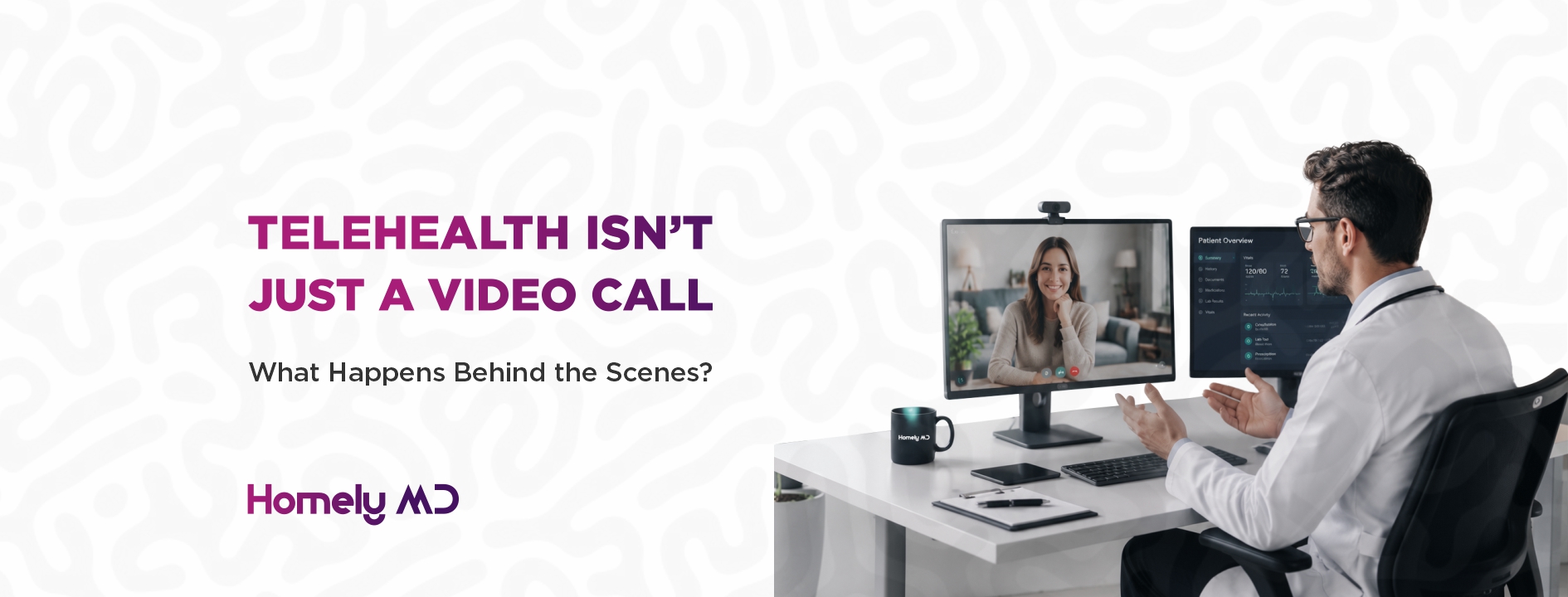
From the patient’s side, telehealth can look pretty simple. But there is a lot more happening behind that screen than a video conversation.
Before the appointment, someone needs to schedule it, collect the patient’s information, make sure the provider has access to the right records, and get everything ready.
During the visit, documentation, prescriptions, lab orders, and patient information may all need to be handled.
And after the call?
There may be billing, follow-ups, messages, referrals, and another appointment to arrange.
The video call is just one part of telehealth services.
The real work happens around it.
The appointment starts before you join the call
Think about what happens before a virtual appointment.
A patient books a time.
They receive confirmation.
They may complete an intake form and provide medical history.
The provider needs access to their records before the consultation begins.
If these steps are happening across different systems, someone on the team has to keep everything connected.
A good telehealth platform helps bring those pieces together so the appointment doesn’t feel like a separate process from the rest of the practice.
What actually happens behind the scenes?
A typical virtual visit can involve a lot more than pressing “Join.”
1. Scheduling
The patient needs to find an available time.
The provider’s calendar needs to be updated.
Confirmation and reminders may need to go out.
A well-connected system can handle these steps without requiring staff to manually coordinate every appointment.
2. Patient intake
Before the consultation, the patient may need to provide their basic information, medical history, consent, or other relevant details.
Digital intake means the provider can have that information before the appointment rather than spending the beginning of the visit collecting paperwork.
3. Patient records
The provider needs context.
What happened during the last visit?
What medications is the patient taking?
Were there recent lab results?
What was discussed previously?
This is where virtual healthcare needs to connect with the patient’s broader record. A video call on its own doesn’t give a provider that context.
4. The actual consultation
Then comes the part everyone sees.
The patient and provider meet virtually.
They discuss concerns, review information, ask questions, and determine the appropriate next steps.
But the work doesn’t stop when the video ends.
And then comes everything after the appointment
This is the part patients don’t always see.
The provider may need to finish documentation.
A prescription might need to be sent.
Lab work may need to be ordered.
A follow-up appointment may need to be scheduled.
The patient might need a message.
Billing needs to be updated.
Someone may need to check whether the patient completed the next step.
Suddenly, that 20-minute virtual visit has created another set of tasks.
That’s why a telehealth platform needs to do more than host video calls.
It needs to support the workflow around the visit too.
Telehealth works best when everything is connected
Imagine this instead.
A patient books an appointment.
Their information is already available.
They complete their intake before the visit.
The provider opens the patient’s record and sees the relevant history.
The consultation happens virtually.
The provider documents the visit.
A prescription or lab order is handled from the same workflow.
The follow-up is scheduled.
The patient receives the appropriate communication.
Nothing feels particularly complicated.
That’s the point.
The technology should make the process feel simple even when there is a lot happening behind the scenes.
The demand for virtual care isn’t going away
According to the American Medical Association, 71.4% of physicians reported using telehealth in 2024, compared with 25.1% in 2018.
That shift tells us something important.
Telehealth isn’t just a temporary solution people use when they can’t get to a clinic.
It’s becoming part of how healthcare is delivered.
And as more practices offer telehealth services, the infrastructure supporting those visits becomes just as important as the video technology itself.
A video platform isn’t the same as a telehealth platform
This distinction gets overlooked.
A video tool can help two people talk to each other.
A telehealth platform should help a healthcare practice actually deliver care.
That means thinking about everything surrounding the consultation:
- Scheduling
- Patient intake
- Electronic health records
- Documentation
- Prescriptions
- Lab workflows
- Billing
- Patient communication
- Follow-ups
- Reporting
The video is one piece.
The workflow is the bigger picture.
What should healthcare providers look for?
If you’re adding or expanding telehealth services, ask a few practical questions:
Does the platform connect with patient records?
Can patients complete intake before the appointment?
Can providers document without jumping between systems?
Can scheduling and follow-ups happen in the same workflow?
Can the platform support both virtual and in-person care?
Will it still work if the practice grows?
These questions are often more useful than simply asking whether the platform has “HD video.”
How Homely MD approaches telehealth
At Homely MD, we don’t see telehealth as a video feature.
It’s part of the larger patient journey.
Our platform connects telehealth with EHR, scheduling, patient intake, AI-assisted documentation, lab workflows, billing, patient communication, and practice management.
That means providers can manage more of what happens before, during, and after a virtual visit without piecing together multiple disconnected systems.
Because patients may only see the video call.
Your team sees everything else.
And that’s exactly why the technology behind virtual healthcare matters.
The best telehealth experience is the one that feels simple
Patients don’t need to know what is happening behind the scenes.
They just want the appointment to work.
They want to find a time that suits them.
They want their provider to have their information.
They don’t want to repeat themselves.
They want their prescription, lab work, or follow-up handled without unnecessary back-and-forth.
For providers, the goal is much the same.
Less switching between systems.
Less manual work.
Fewer things to chase.
More time spent actually caring for patients.
That’s what good telehealth services should feel like.
Simple on the surface.
Well connected underneath.
Get in touch!
FAQs
Is telehealth just a video appointment?
No. The video visit is only one part of the process. Scheduling, intake, records, documentation, prescriptions, billing, and follow-ups can all happen around the consultation.
What’s the difference between a video tool and a telehealth platform?
A video tool mainly facilitates communication. A telehealth platform is designed to support the broader workflow involved in delivering virtual care.
Can virtual healthcare include follow-up care?
Yes. Depending on the service and patient’s needs, follow-ups can be an important part of a virtual care model.
Does telehealth replace in-person care?
Not necessarily. Many practices use a combination of virtual and in-person visits depending on what the patient needs.
What should a practice look for in a telehealth platform?
Look for something that connects the virtual visit with the rest of your workflow, including patient records, scheduling, documentation, communication, billing, and follow-up care.