Do you ever finish seeing patients and realize you still have hours of work left??
The appointments are done.
The waiting room is empty.
But your day isn’t over.
There are notes to finish, records to update, messages to answer, appointments to schedule, bills to check, and follow-ups to remember.
For many Healthcare Providers, the problem isn’t seeing patients. It’s everything that happens around each appointment.
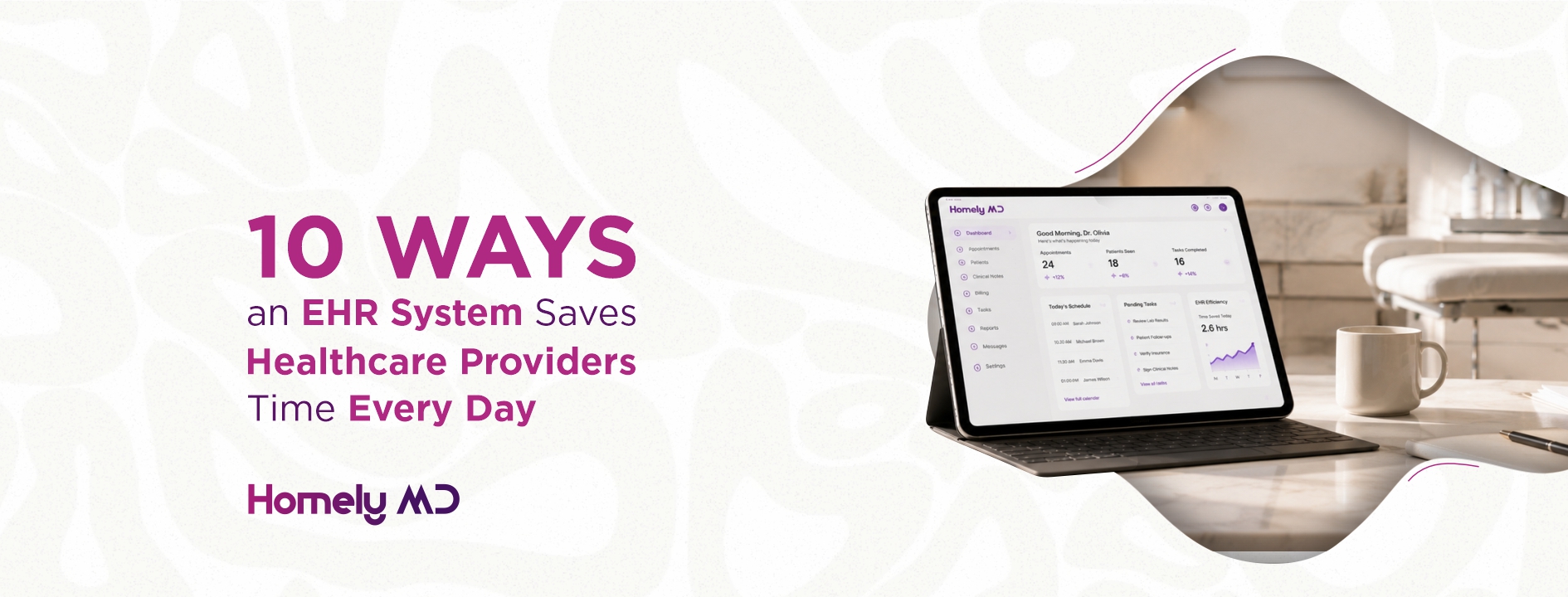
A modern EHR system can help healthcare providers reduce administrative tasks, streamline workflows, and spend more time focused on patient care.
A good EMR system can take some of that work off your plate by bringing everyday tasks into one connected workflow.
Here are 10 ways it can save your team time.
1. Less time entering the same information..
Nobody wants to type the same patient details into three different systems.
A connected EHR can keep information in one place, so your team isn’t constantly copying and pasting between platforms.
It’s a small change, but when you’re doing it all day, you notice the difference.
2. Faster patient intake
Paperwork has a way of making a five-minute process feel much longer.
Patients fill out forms, your staff enters the same information into the system, and someone has to check that everything is there before the appointment can really get started.
With digital intake, patients can fill things out before they arrive. Your team can look everything over in advance, so when the patient walks in, you’re actually ready for them.
Less paperwork. Less back-and-forth. A smoother start to the appointment.
3. Easier scheduling
Scheduling shouldn’t feel like a group project.
A patient asks for an appointment. The front desk checks the provider’s availability. Someone sends a message. The time changes. Then there’s a cancellation that needs to be updated everywhere.
An integrated system keeps availability, appointments, and cancellations in one place.
Your team can see what’s open, book the appointment, and move on to the next thing instead of spending half the day coordinating calendars.
4. Less time spent documenting..
Documentation is necessary.
Spending hours catching up on it after clinic isn’t ideal.
Modern EHR platforms can support templates, automated workflows, and AI-assisted documentation to reduce some of the repetitive work involved in creating and updating patient records.
The provider remains in control. The software simply helps with the busywork.
5. Patient information is easier to find..
We’ve all had that moment:
“I know this patient’s report is somewhere.”
Then comes the search.
An organized EMR system keeps records, notes, lab information, and other relevant patient details together, so providers don’t have to waste valuable time looking through different platforms.
6. Follow-ups don’t get forgotten..
A patient’s care doesn’t end when the appointment does.
There may be a follow-up call, another appointment, lab results to review, or a treatment plan to revisit.
Healthcare workflow automation can help create reminders and tasks so your team doesn’t have to rely on sticky notes, spreadsheets, or memory.
7. Telehealth becomes part of the workflow..
Virtual appointments can become messy when the video platform, patient record, scheduling system, and documentation tools all live separately.
When telehealth is connected to your EHR, providers can move through the appointment without constantly switching systems.
The technology becomes part of the visit rather than another thing to manage.
8. Billing doesn’t have to become another daily headache
Billing is one of those things that can quietly eat up a lot of your team’s time.
An appointment happens, then someone has to update the billing, check the payment, follow up on anything pending, and make sure nothing was missed.
When your EMR system connects appointments with billing and recurring payments, a lot of those little steps can happen without someone constantly checking and updating everything by hand.
It’s not flashy. It just means your team has fewer things to chase at the end of the day.
9. Your team spends less time switching between systems..
This one sounds obvious, but it’s often the biggest time saver.
One system for records.
Another for scheduling.
Another for telehealth.
Another for billing.
Another for communication.
Before you know it, your team is spending half the day moving between tabs.
A connected EHR brings more of those workflows together.
10. You can automate the little things..
This is where Healthcare workflow automation really starts to matter.
Appointment reminders.
Patient communications.
Follow-up tasks.
Documentation support.
Recurring billing.
Internal notifications.
These aren’t complicated jobs, but they don’t necessarily need a person doing them manually every single time.
Automating the repetitive parts gives your team more room to focus on the work that actually requires a human being.
A simple checklist before choosing an EHR
If you’re considering a new EMR system, don’t just ask how many features it has.
Ask:
- Will it actually save my team time?
- Can our patient information stay connected?
- Does it reduce duplicate data entry?
- Can it support telehealth?
- Does it offer workflow automation?
- Can providers document without unnecessary steps?
- Can it grow with our practice?
- Will our staff actually find it easy to use?
Because the most advanced system in the world isn’t useful if your team needs ten extra steps to complete a simple task.
What this looks like at Homely MD..
At Homely MD, the idea is pretty straightforward.
Healthcare Providers shouldn’t have to spend their day managing the technology that’s supposed to help them.
Homely MD brings together patient records, scheduling, telehealth, billing, AI-assisted documentation, communication, reporting, and practice management in one connected platform.
The goal isn’t to add more software to your day.
It’s to take some of the repetitive work out of it.
Because when your systems handle the small things more efficiently, your team has more time for the things that actually matter: your patients, your practice, and your growth.
Get in touch!
FAQs
Can an EHR really save that much time?
It can.. especially when it replaces repetitive tasks like duplicate data entry, manual reminders, and switching between multiple systems..
Is an EMR system useful for small practices?
Absolutely. Small teams often have fewer people to handle administrative work, so saving even a few minutes per appointment can make a noticeable difference..
What is healthcare workflow automation?
It’s the use of technology to handle repetitive steps in a healthcare workflow, such as reminders, follow-up tasks, communications, and documentation support..
Will an EHR replace my staff?
No. A good system should support your team, not replace the human side of healthcare. The idea is to give your staff fewer repetitive tasks to worry about..
What should I look for in an EHR?
Look beyond the feature list. Choose a system that connects your workflows, is easy for your team to use, supports automation, and can grow with your practice..