Your clinic probably doesn’t have a time problem.
It has a workflow problem.
A patient books through your website. Your CRM captures the lead. Your front desk sends an intake form. The provider checks another system for labs. The visit gets documented in the EHR. A prescription goes to the pharmacy. Billing happens somewhere else.
And then someone usually very busy has to make sure all those systems actually agree.
That’s how a 10-minute administrative task becomes a 30-minute one.
And when you’re seeing dozens of patients every week, those little inefficiencies don’t stay little for long.
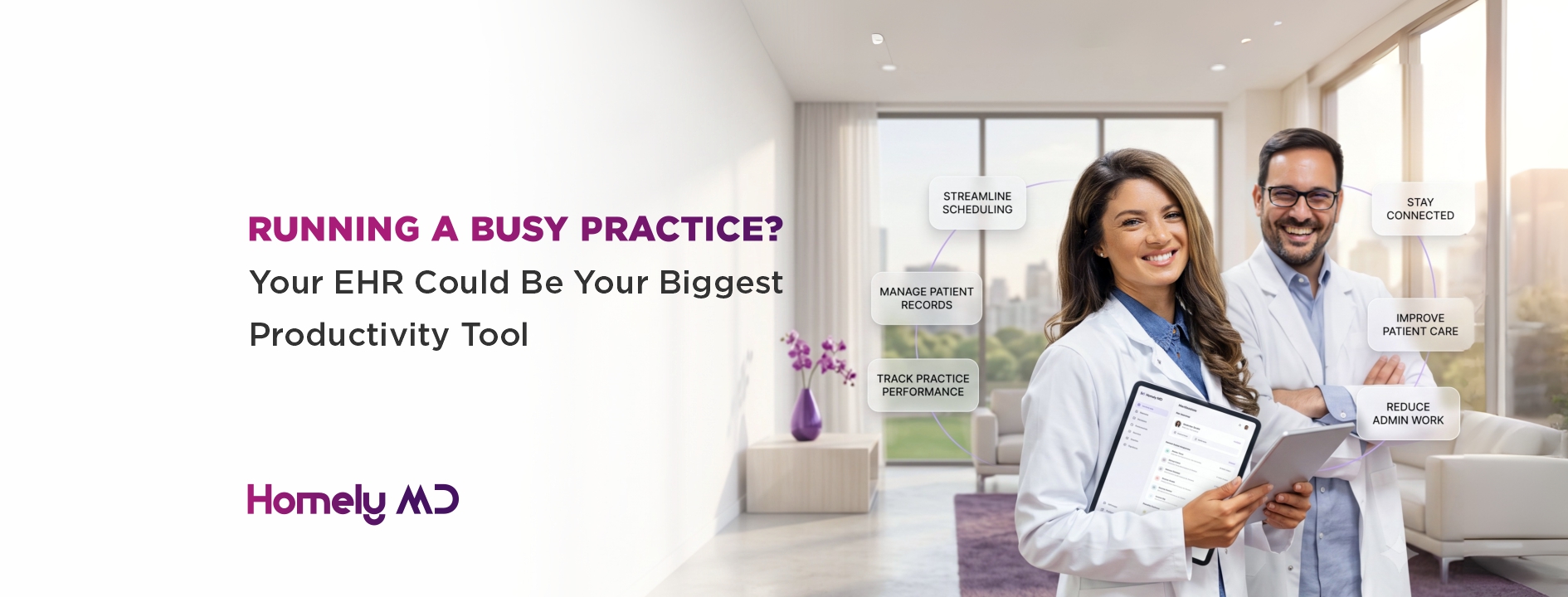
This is where the right EHR software can become much more than a digital patient chart.
It can become one of the biggest productivity tools in your practice.
Your EHR Shouldn’t Create More Work
Let’s imagine a typical wellness clinic.
A new patient discovers you through an Instagram ad.
They click.
They fill out a form.
They book a consultation.
Then what?
If your systems are disconnected, the journey might look something like this:
Ad → CRM → Phone call → Scheduling platform → Intake form → EHR → Lab portal → Pharmacy → Billing software → Spreadsheet
That’s a lot of places for information to get lost.
Maybe the lead never makes it into the patient record.
Maybe the provider doesn’t see a lab result until later.
Maybe someone forgets to follow up.
Maybe your clinic generates $500 from a patient but nobody knows that $150 of that went toward acquisition, $80 toward pharmacy, and another amount toward labor and labs.
The technology is technically there.
The workflow isn’t.
And that’s the difference modern healthcare businesses need to start paying attention to.
The Real Productivity Test for EHR Software
When clinics shop for an EHR, the conversation usually turns into a feature checklist.
Does it have SOAP notes?
Does it have scheduling?
Does it support e-prescribing?
Does it have telehealth?
Does it integrate with labs?
All reasonable questions.
But there’s another question that’s arguably more important:
How many tasks does this system eliminate for my team?
That’s the productivity test.
Because adding another piece of software doesn’t automatically make a practice more efficient.
Connecting the work does.
The Office of the National Coordinator for Health IT continues to track the expansion of certified health IT and interoperability across U.S. healthcare, highlighting just how central connected digital systems have become to modern care.
The opportunity for private practices is to take that same idea beyond basic recordkeeping.
Your EHR shouldn’t just store what happened.
It should help move the practice forward.
7 Ways the Right EHR Can Make a Busy Practice More Productive
1. Stop Entering the Same Information Twice
This is one of those productivity drains that nobody notices until they add it all up.
A patient enters their information on your website.
Someone puts it into the CRM.
The patient completes an intake form.
Someone updates the EHR.
The provider adds more information.
Billing needs something else.
The pharmacy needs something else.
Suddenly, three people have touched the same patient information before the appointment even happens.
Good EHR software for healthcare providers should reduce that repetition.
Information should move with the patient instead of requiring your staff to constantly move it themselves.
Five minutes saved on one patient doesn’t sound dramatic.
Five minutes saved across hundreds of patient interactions?
Now you’re talking about real operational capacity.
2. Give Providers the Full Picture Before the Appointment
A provider shouldn’t have to play detective before seeing a patient.
They may need to review:
- Previous encounters
- Lab results
- Medications
- Treatment plans
- Patient history
- Previous notes
- Follow-up tasks
- Relevant communications
If that information is scattered across four different platforms, the provider becomes the integration layer.
That’s not what a provider should be spending their time doing.
The right EHR software for healthcare providers should make relevant patient information easier to access within the clinical workflow.
Less searching.
Less clicking.
More time focused on the patient.
3. Turn Lab Results Into Workflow
Here’s where EHR technology gets particularly interesting for modern wellness practices.
A lab result arrives.
Traditional workflow:
Result → Review → Document → Done
A more connected workflow can look like:
Result → Structured data → Clinical review → Flag → Follow-up task → Patient communication
That’s a big difference.
The system isn’t replacing clinical judgment.
It’s helping make sure information doesn’t disappear into a PDF that nobody remembers to revisit.
For practices offering TRT, HRT, weight management, GLP-1 programs, peptide therapy, functional medicine, or longevity services, that kind of workflow can become especially valuable.
4. Bring Telehealth and In-Person Care Together
Your patients don’t think:
“Today I’m entering the telehealth workflow.”
They think:
“I have an appointment.”
It could be in the clinic.
It could be at home.
It could happen through video.
Your EHR should be able to support the patient’s journey without making your staff maintain completely separate processes.
This becomes even more important as wellness practices expand beyond one location or one type of appointment.
A connected system can give providers and staff a more consistent view of the patient regardless of where the encounter takes place.
5. Connect Marketing to Patient Acquisition
Here’s a question every growing clinic should be able to answer:
Where are our best patients actually coming from?
Not just leads.
Patients.
And ideally, profitable patients.
Your marketing platform might tell you that a campaign generated 100 leads.
Your scheduling software might tell you that 30 booked.
Your EHR might tell you that 22 actually became patients.
But if none of those systems communicate, you’re left piecing the story together manually.
Connecting the CRM and EHR changes that.
You can start looking at the journey as:
Campaign → Lead → Appointment → Treatment → Revenue
That’s far more useful than simply counting leads.
6. Automate the Work Around the Patient
Not everything in healthcare should be automated.
Clinical judgment shouldn’t be.
Patient relationships shouldn’t be.
But plenty of repetitive administrative work can be.
Think about:
- Appointment reminders
- Intake
- Scheduling
- Billing
- Subscription management
- Follow-up tasks
- Lab notifications
- Prescription workflows
- Staff assignments
- Reporting
The best systems don’t try to replace your team.
They give your team fewer repetitive things to do.
That’s the real promise of an All-in-One Platform for healthcare providers.
Not “one dashboard because dashboards are cool.”
One connected workflow because your staff shouldn’t have to manually connect everything themselves.
7. Understand What Your Patients Are Actually Worth
Revenue can be misleading.
Let’s say a patient generates $600 per month.
Great.
But what’s left after:
- Customer acquisition
- Provider labor
- Labs
- Pharmacy
- Payment processing
- Other operational costs?
That’s the number that matters to a business owner.
This is where EHR technology can start moving beyond clinical documentation and into practice intelligence.
Imagine being able to see patient revenue alongside the costs associated with acquiring and serving that patient.
Suddenly, you can start asking better questions:
Which acquisition channels produce the best patients?
Which services have the strongest margins?
Which subscriptions are underpriced?
Which patient programs are costing more to operate than expected?
That’s a very different way of thinking about an EHR.
Why This Matters So Much for Wellness Clinics
Modern wellness practices aren’t always running a simple “visit → bill → done” model.
A single patient may interact with your business through:
Consultation + Labs + Medication + Supplements + Membership + Follow-Up + Telehealth
That’s a connected business model.
So your technology needs to be connected too.
The best ehr for wellness clinics isn’t necessarily the platform with the most buttons.
It’s the one that understands how modern wellness care actually works.
If you’re running TRT, HRT, GLP-1, weight management, peptide, functional medicine, longevity, or MedSpa services, your technology should support the entire patient journey—not just the clinical note.
What Should You Look For in EHR Software?
Before switching systems, forget the feature checklist for a minute.
Look at your actual day.
Then ask:
Does patient information move automatically?
If your staff is copying information between systems, there’s probably an opportunity to simplify the workflow.
Can the platform support your care model?
Do you offer in-person care?
Telehealth?
At-home services?
Multiple locations?
Your EHR shouldn’t force you into a workflow that doesn’t match how your practice operates.
Does it support your specialty?
A traditional primary-care workflow isn’t necessarily ideal for a wellness business offering TRT, HRT, weight management, peptides, or recurring programs.
Can it connect clinical and business information?
Clinical documentation tells you what happened with the patient.
Business data tells you what happened with the practice.
Having both perspectives can help owners make better operational decisions.
Can it scale with you?
The system that works for one provider isn’t automatically the system you’ll want when you have five providers, three locations, telehealth, at-home care, and hundreds of recurring patients.
Think about where you’re going—not just where you are.
The EHR Question Nobody Asks
Here’s the question I would put at the top of every EHR evaluation:
What work disappears if we implement this?
Not:
“How many features does it have?”
Ask:
Will my front desk still have to enter the same patient information twice?
Will providers still have to search multiple portals for labs?
Will someone still reconcile pharmacy costs manually?
Will my marketing team still struggle to connect campaigns with actual patients?
Will I still need a spreadsheet to understand patient profitability?
If the answer is yes to all of them, you may have an EHR.
You just don’t necessarily have a connected practice.
Why Homely MD Takes a Different Approach
Homely MD was built around a simple idea:
Your clinical system shouldn’t be disconnected from the business you’re building around it.
That’s why Homely MD brings together the infrastructure modern wellness practices need, including:
- Clinical charting and SOAP notes
- CRM and lead capture
- Telehealth
- AI lab intelligence
- 503A and 503B pharmacy infrastructure
- Billing and subscriptions
- Per-patient P&L
- In-clinic and at-home workflows
- Multi-clinic support
- Provider infrastructure
Instead of making your team jump between systems, the goal is to connect the patient journey from the first lead all the way through care, fulfillment, billing, and profitability.
That’s what makes an All-in-One Platform for healthcare providers useful.
Not because everything is crammed into one product.
Because the pieces actually work together.
Your EHR Should Give Time Back
Healthcare will always need people.
Providers will make clinical decisions.
Nurses will care for patients.
Front-desk teams will build relationships.
Technology should make all of that easier—not bury those people under administrative work.
The right EHR software can become the operating layer connecting your patients, providers, labs, pharmacy, billing, marketing, and business operations.
And that’s when an EHR becomes a genuine productivity tool.
Not because it helps someone type a note 30 seconds faster.
But because it removes dozens of tiny tasks that never should have required human attention.
Those minutes add up.
Those hours add up.
And eventually, they show up in your patient experience, your team’s workload, and your bottom line.
Is Your EHR Helping Your Practice—or Making Your Team Work Around It?
If your staff is constantly switching between platforms just to move one patient from lead to treatment, it may be time to rethink your technology stack.
Homely MD connects clinical workflows, telehealth, labs, pharmacy, billing, CRM, and practice economics in one platform built for modern wellness care.
The right system should make your practice easier to run, not give your team another system to run.
Get in touch with Homely MD to see what a connected EHR workflow could look like for your practice.
Frequently Asked Questions
What is EHR software?
EHR software is a digital system for managing patient records, clinical documentation, treatment plans, and other healthcare workflows.
What should healthcare providers look for in EHR software?
Look for clinical functionality, integrations, security, scalability, specialty support, and workflows that reduce administrative work.
What is the best EHR for wellness clinics?
The best ehr for wellness clinics depends on the clinic’s services, workflows, patient volume, and technology needs.
Can nurse practitioners use EHR software for their own practice?
Yes. ehr software for nurse practitioners can support documentation, scheduling, patient records, prescriptions, billing, and other practice workflows.
Can an EHR replace multiple healthcare business tools?
Some modern platforms can combine EHR, CRM, telehealth, billing, lab, pharmacy, and reporting workflows, reducing the need for disconnected tools.