For years, the idea of growing a healthcare practice looked almost identical for everyone.
Find a location.
Sign a lease.
Spend months setting it up.
Hope enough patients walk through the door.
Somewhere along the way, that became the accepted formula for success.
The problem is that it doesn’t fit the way healthcare works anymore.
Providers are moving faster. Patients expect convenience. Telehealth has changed expectations, and wellness businesses are expanding into markets they never would have considered a few years ago.
Yet many providers are still expected to commit to a five-year lease before they know whether a new location will even work.
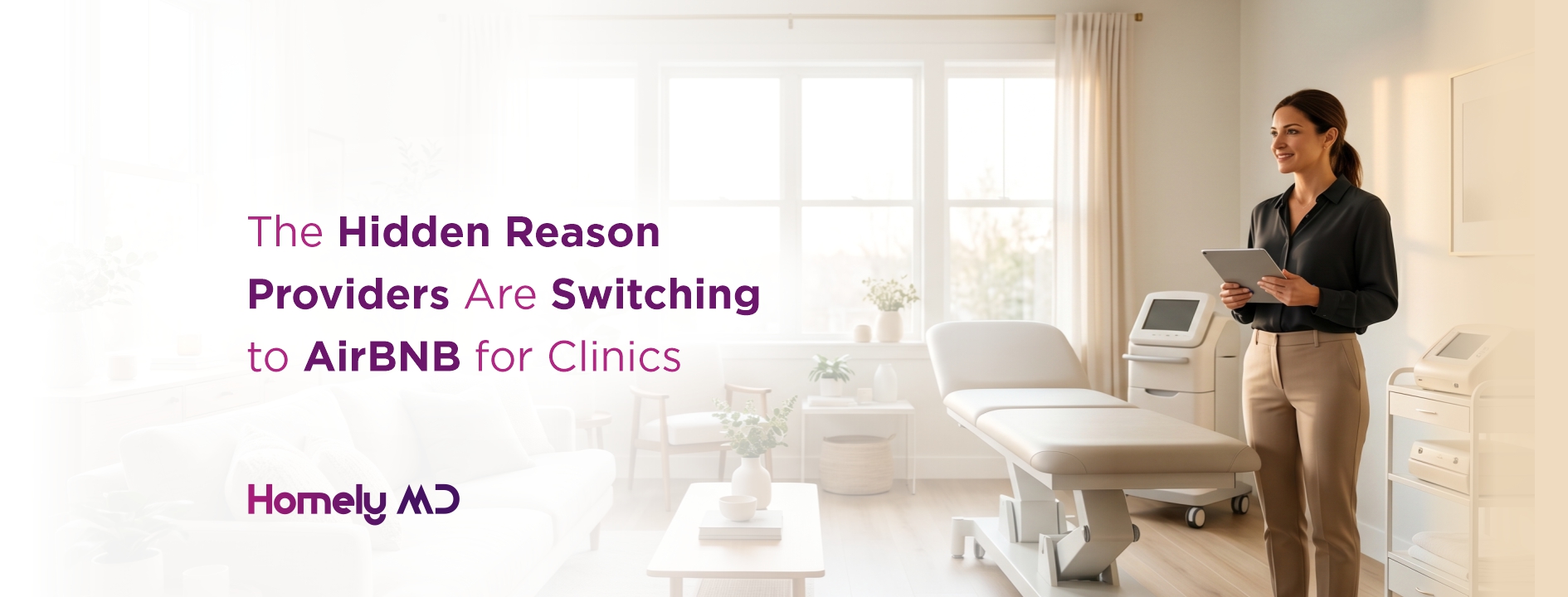
That’s probably the biggest reason interest in the AirBNB for Clinics model keeps growing.
It’s not about avoiding commitment.
It’s about reducing unnecessary risk.
The conversation has quietly changed
According to JLL’s 2025 Medical Outpatient Building Perspective, healthcare providers are increasingly expanding outpatient services while prioritizing operational efficiency and more flexible real estate strategies instead of traditional infrastructure-heavy models. As care continues shifting beyond hospital walls, providers are looking for smarter ways to access clinical space without taking on unnecessary long-term overhead.
Talk to independent providers or founders of wellness brands and you’ll hear the same frustration.
The demand is there.
The patients are there.
The opportunity is there.
What’s missing is affordable infrastructure.
Opening another location sounds exciting until you start calculating the costs. Rent, renovations, equipment, compliance, staffing, utilities, insurance. The list keeps growing before the first patient even books an appointment.
For many businesses, expansion stalls before it even begins.
Not because they lack ambition.
Because the numbers don’t make sense.
Ownership isn’t always the goal anymore
A few years ago, owning a clinic felt like a milestone.
Today, flexibility has become just as valuable.
Many providers don’t need another permanent address.
They need a professional room to treat patients one afternoon a week.
Or somewhere to offer injections while building a local patient base.
Or a treatment room while testing demand in a completely new city.
That’s where flexible clinic space is changing the conversation.
Instead of investing heavily in property, providers can invest in growth.
There’s a big difference.
Growing carefully isn’t the same as thinking small
One mistake people make is assuming flexible models are only for startups.
They’re not.
Established practices are using them too.
Some are launching satellite locations.
Others are adding longevity, weight management, or wellness services without opening another clinic.
Some simply want to see patients closer to where they live.
The common theme isn’t budget.
It’s agility.
Healthcare businesses want room to move without carrying unnecessary overhead.
Test first. Expand later.
This is probably the biggest advantage nobody talks about.
Imagine wanting to expand into another city.
The traditional approach says to lease a property, fit it out, hire staff, and then hope enough patients arrive.
Most industries don’t work like that anymore.
They validate demand first.
Healthcare is finally starting to adopt the same mindset.
Providers can establish a presence, build relationships, and understand local demand before making long-term commitments.
That feels like a much smarter way to grow.
The job is healthcare, not property management
Ask most clinicians what they enjoy about running a practice.
Very few will say commercial leases.
Or maintenance issues.
Or managing empty treatment rooms.
Most simply want to deliver good care and build a sustainable business.
Infrastructure should support that goal, not become another full-time responsibility.
That’s another reason healthcare providers looking for clinic space are exploring more flexible operating models.
Less time worrying about buildings usually means more time focusing on patients.
Healthcare is becoming more adaptable
The industry is changing in small ways that are adding up quickly.
More hybrid care.
More wellness programs.
More concierge services.
More telehealth.
More mobile healthcare.
It makes sense that the physical spaces supporting providers would evolve too.
The future probably won’t belong only to large permanent clinics or tiny private practices.
It will belong to businesses that can adapt quickly as patient needs change.
That’s exactly what flexible infrastructure makes possible.
At Homely MD, we’re building a nationwide network of treatment rooms that gives providers more freedom to launch, expand, and serve patients without the traditional barriers that often slow growth.
Get in touch to discover how AirBNB for Clinics can help your business grow through smarter access to flexible clinic space.
FAQs
Is this mainly for new providers?
Not really. Some of the biggest interest actually comes from established practices that want to expand without opening another permanent location straight away.
Who usually looks for flexible clinic space?
It varies quite a bit. Physicians, nurse practitioners, wellness businesses, telehealth brands, injectors, and specialists all use these spaces depending on what they’re building.
Why are healthcare providers looking for clinic space differently now?
Because the old model doesn’t fit every business anymore. Many providers want flexibility before they take on major overhead.
Does using flexible clinic space make a practice look less established?
Not at all. Patients care far more about quality of care than whether the treatment room is owned or leased.
Is AirBNB for Clinics replacing traditional clinics?
Probably not. It’s simply giving providers another option that fits modern healthcare a little better than the old way of doing things.