Table of Contents
Expanding a healthcare business often requires more than attracting new patients. Providers must consider where care will be delivered, how much additional space is needed, and whether a new location can support its operating costs.
For growing practices, the traditional approach of leasing and equipping another medical office may create a significant financial commitment. An Airbnb for clinics model offers an alternative worth evaluating: accessing suitable clinical space as business needs evolve.
How Flexible Clinic Space Supports Healthcare Business Expansion
Healthcare businesses do not always need to establish a permanent location before exploring a new market. Depending on the services offered, flexible clinic arrangements may provide a way to assess demand, introduce selected appointment days, and determine whether a longer-term expansion makes sense.
1. Test New Markets Before Making Major Commitments
Suppose an established practice wants to reach patients in another city. Signing a long-term lease immediately may be premature if local demand is uncertain.
Access to suitable clinic space could allow the business to introduce scheduled appointments and evaluate patient interest before deciding whether to establish a permanent location.
Providers should assess local competition, travel requirements, booking costs, and the time needed to build a consistent patient base.
2. Expand Services Without Automatically Expanding Facilities
A practice may want to introduce a new service that requires additional clinical space for only a limited number of appointments.
Rather than immediately increasing its permanent footprint, the business can compare the costs and practicalities of using an appropriate shared facility.
The right decision depends on equipment requirements, patient volume, staffing, and the clinical environment needed for the service.
3. Align Space With Actual Demand
A healthcare business may experience seasonal fluctuations or different appointment volumes across locations.
Flexible workspace arrangements can provide additional options when demand changes. However, providers should confirm that rooms will be available when required and that the arrangement can accommodate patient scheduling needs.
4. Make Expansion Decisions With Better Cost Visibility
Before opening another location, compare the expected costs of flexible access with those of a conventional clinic.
Consider rent, deposits, utilities, equipment, staffing, insurance, cleaning, maintenance, and any booking or service fees. Include the expected number of appointments and realistic revenue assumptions.
A flexible arrangement is not automatically less expensive, but a structured comparison can help business owners choose an appropriate expansion strategy.
A Practical Framework for Scaling a Medical Practice
Before entering a new market, healthcare business owners should work through four steps:
Step 1: Validate demand. Research the local patient population, competition, and likely appointment volume.
Step 2: Define facility requirements. Determine the type of room, equipment, accessibility, privacy, and operating hours needed.
Step 3: Compare available arrangements. Evaluate flexible clinic access, subleases, and traditional leases against the same cost and operational criteria.
Step 4: Review results before expanding. Track appointment utilization, patient feedback, operating costs, and revenue to decide whether the next stage of expansion is justified.
Providers must also confirm that the selected facility and operating arrangement meet applicable licensing, credentialing, insurance, privacy, and patient-safety requirements.
How Homely MD Supports a More Flexible Healthcare Model
Homely MD combines technology-enabled healthcare services with an Airbnb-inspired clinic model. Participating clinics can make available rooms accessible to providers, while healthcare professionals can explore opportunities to deliver services through a more flexible care network.
This model may be relevant to independent practitioners and growing healthcare businesses evaluating how to access clinical space without immediately establishing another permanent facility.
The suitability of any arrangement depends on location, service requirements, availability, and applicable participation terms.
Ask most healthcare providers what holds them back from growing, and the answer usually isn’t patient demand.
It’s everything around it.
The lease.
The build-out costs.
The empty treatment rooms during slower months.
The pressure of committing to a larger clinic before knowing if a new location will actually work.
For years, healthcare business growth followed a familiar pattern. If you wanted to grow, you needed more space. More staff. More infrastructure.
That model worked for some.
For many providers today, it feels unnecessarily expensive.
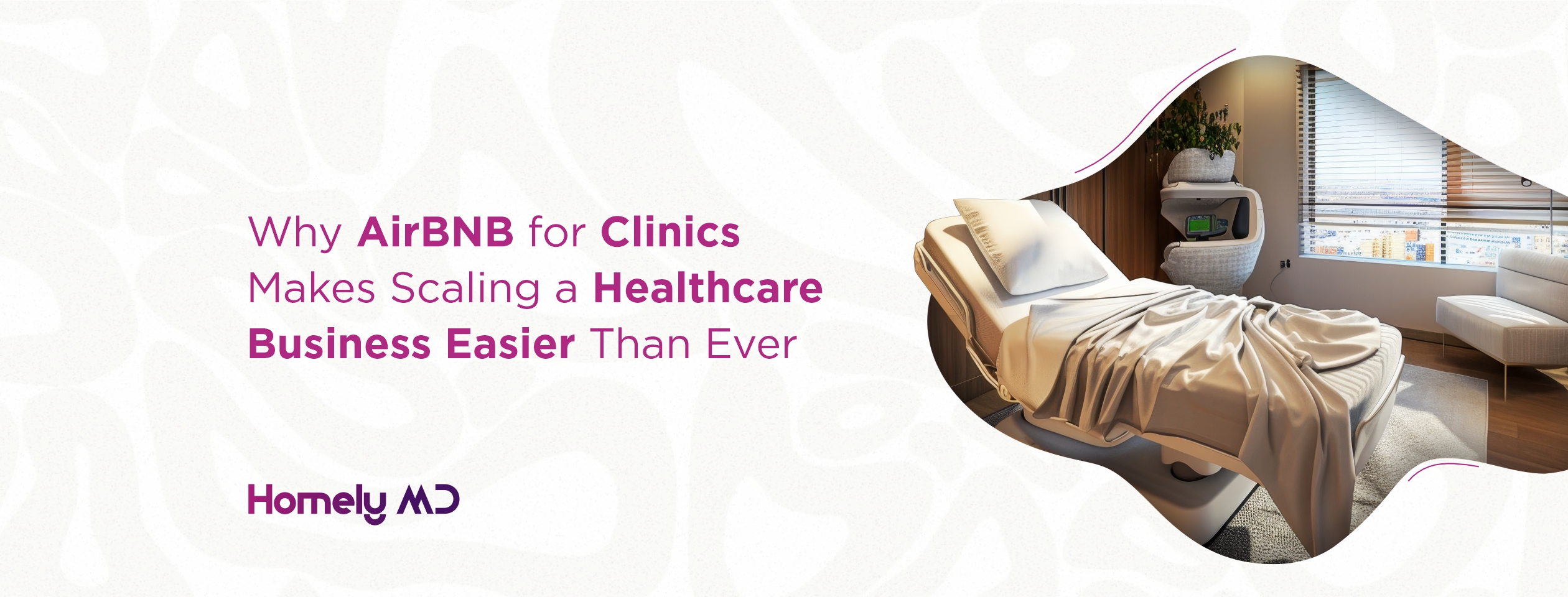
This is exactly why the idea of an AirBNB for Clinics model is gaining attention across healthcare.
Not because providers want shortcuts.
Because they want flexibility.
Growth Shouldn’t Require a Massive Gamble
Many providers face the same challenge.
They have the skills.
They have a patient demand.
They have a vision for expansion.
What they don’t always have is the appetite for signing a long-term lease, investing heavily in fit-outs, and carrying overhead costs before revenue catches up.
Growth becomes a gamble.
Expand too soon and costs pile up.
Wait too long and opportunities disappear.
This is where an On demand clinic model changes the equation.
Instead of building infrastructure first and hoping demand follows, providers can access professional clinical spaces as demand grows.
The Traditional Expansion Model Has Problems
Opening a new location sounds exciting until the invoices start arriving.
Healthcare providers often face:
- Long lease commitments
- High upfront investment
- Equipment costs
- Staffing requirements
- Underutilized clinic hours
- Ongoing operational expenses
The reality is that many practices spend months paying for capacity they are not fully using.
That slows growth.
And sometimes, it stops it completely.
Why Providers Are Looking for More Flexible Models
Healthcare itself has changed.
Patients expect flexibility.
Providers do too.
Many clinicians now work across multiple locations, offer hybrid services, provide virtual consultations, or serve niche patient groups.
A fixed infrastructure model doesn’t always support that reality.
An AirBNB for Clinics approach gives providers access to professional treatment environments without forcing them into permanent commitments immediately.
That flexibility matters.
Especially during growth phases.
Test Before You Invest
One of the biggest advantages of an On demand clinic model is the ability to validate demand before making major decisions.
Let’s say a provider wants to expand into a new area.
Traditionally, they might need to:
- Lease a space
- Renovate it
- Hire staff
- Invest in operations
All before knowing whether patient demand will support the expansion.
A flexible clinic model allows providers to test new markets first.
That reduces risk significantly.
Healthcare Business Growth Looks Different Today
A few years ago, growth was often measured by square footage.
Bigger clinic.
More rooms.
More locations.
Today, providers are asking different questions.
How quickly can we adapt?
How efficiently can we operate?
How can we serve more patients without increasing overhead unnecessarily?
Those questions are shaping modern healthcare business growth strategies.
Infrastructure Should Support Growth, Not Slow It Down
The best healthcare businesses are usually focused on patient care and operational efficiency.
They are not trying to become property management companies.
Yet, many providers spend enormous amounts of time managing facilities, leases, maintenance issues, and infrastructure concerns.
That energy could be spent elsewhere.
An AirBNB for Clinics model allows providers to focus more on:
- Patient experience
- Service quality
- Expansion opportunities
- Business development
Instead of worrying about unused treatment rooms.
Why Smaller Practices Benefit Most
Large healthcare organizations often have the resources to absorb infrastructure costs.
Independent providers do not always have that luxury.
For smaller practices, flexibility can be a competitive advantage.
Instead of waiting years to expand, providers can:
- Enter new markets faster
- Offer services in multiple locations
- Reduce upfront investment
- Scale more gradually
That creates opportunities that traditional clinic models sometimes make difficult.
The Rise of On-Demand Healthcare Infrastructure
The concept isn’t actually unusual when you think about it.
Many industries already use flexible infrastructure models.
Businesses rent office space on demand.
Professionals use coworking spaces.
Retail brands test pop-up locations before opening permanent stores.
Healthcare is beginning to move in a similar direction.
According to JLL’s Healthcare Real Estate Outlook, providers are increasingly exploring flexible real estate strategies to improve operational efficiency and reduce long-term infrastructure risk.
The industry is slowly recognizing that flexibility can support growth without compromising quality.
What Providers Really Want
Most providers aren’t looking for the cheapest option.
They are looking for the smartest one.
They want:
- Professional environments
- Flexibility
- Scalability
- Lower operational risk
- Better use of resources
An On demand clinic model addresses many of those needs directly.
A Smarter Way to Grow
The future of healthcare expansion may not be about building bigger from day one.
It may be about building smarter.
Flexible clinic infrastructure gives providers the ability to grow based on actual demand instead of assumptions.
For many healthcare businesses, that can mean faster expansion, lower risk, and more sustainable growth.
At Homely MD, the focus is on helping providers access modern infrastructure solutions that support real-world healthcare business growth without the traditional barriers that often slow it down.
Get in touch with Homely MD to learn how flexible clinic space solutions can help support your next stage of growth.
Frequently Asked Questions
How can Airbnb for clinics help scale a healthcare business?
It can provide an alternative way to access clinical space when evaluating new markets, adding appointment locations, or expanding selected services.
Can a healthcare business test a new market without opening a permanent clinic?
In some cases, yes. A suitable flexible clinic arrangement can provide an opportunity to assess demand before committing to a permanent location.
Is flexible clinic space always cheaper than leasing a medical office?
No. Costs depend on utilization, room rates, equipment, staffing, and other operating expenses. Businesses should compare total costs before choosing an arrangement.
Who should consider flexible clinic arrangements?
Independent practitioners and growing practices may consider them when they need occasional space, want to explore another location, or plan to introduce selected services.
What should a provider evaluate before expanding into a new location?
Providers should review patient demand, facility suitability, operating costs, staffing, licensing, insurance, privacy, and the practical requirements of delivering care.