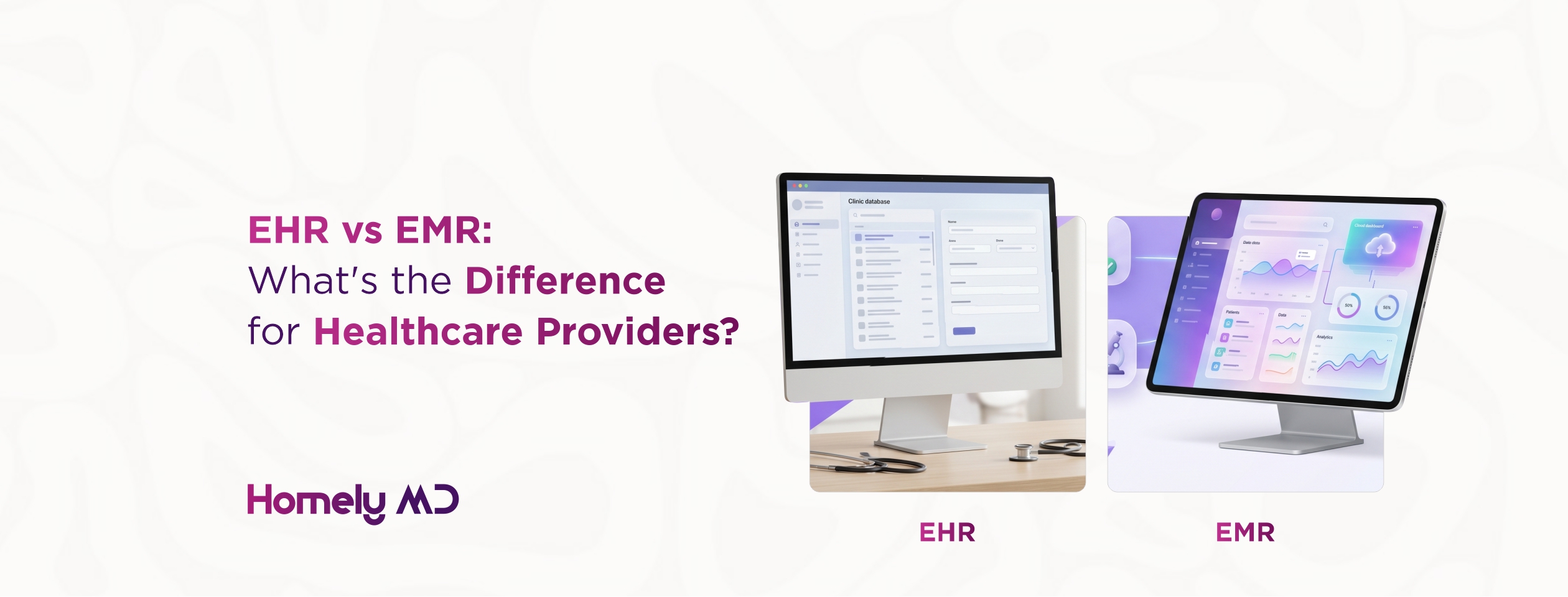
If you have ever sat through a healthcare software demo and wondered whether EHR vs EMR is a real distinction or just two acronyms being thrown around, you are not alone.
The terms are constantly mixed up.
One vendor says EHR.
Another says EMR.
A third uses both on the same page.
And if you are a physician, nurse practitioner, telehealth founder, or someone building a new healthcare business, the difference can feel unnecessarily complicated.
But it matters, especially once your practice starts growing.
Because choosing a system is not really about where you store patient notes. It is about how well your entire operation can move.
Understanding the difference between EHR and EMR is essential when choosing the right EHR/EMR software for your healthcare practice.
Start with the simple version
An EMR is generally focused on the patient record inside one practice.
An EHR is broader. It is built around a more complete, longitudinal view of the patient and is typically better suited to information exchange and coordinated care across different settings.
So, in plain English:
Electronic Medical Records help document care within a practice.
Electronic Health Records are designed to support a wider care journey.
There is overlap, of course. A lot of modern platforms blur the line. But the underlying difference is still useful when you are deciding what your business actually needs.
What are Electronic Medical Records?
Think of an EMR as the digital version of the old patient chart.
A patient comes in.
You document the visit.
You update diagnoses.
You record treatment history.
You add clinical notes.
Everything stays organized within the practice.
For a smaller or highly focused clinic, Electronic Medical Records may cover the essentials perfectly well.
The limitation usually becomes clearer when care starts moving outside that one environment.
Say your patient needs a lab draw.
Or sees another specialist.
Or receives virtual care from a different provider.
Or moves between an in-person clinic and an at-home service.
Now the record has to move too.
That is where things can get messy.
An EHR is built for a bigger picture
Electronic Health Records are generally designed to follow the patient across a broader care journey.
Instead of thinking:
What happened during this visit?
The system is closer to thinking:
What information does the care team need to understand this patient over time?
That may include:
- Medical history
- Diagnoses
- Medications
- Lab results
- Clinical documentation
- Care plans
- Provider notes
- Information shared across authorized care settings
And this is no longer a niche piece of healthcare technology.
According to the U.S. Office of the National Coordinator for Health Information Technology, 95% of U.S. office-based physicians had adopted some form of EHR by 2024, while 91% had adopted a certified EHR. That is a major jump from 2008, when only about 4 in 10 physicians used any EHR at all.
Those numbers make one thing pretty clear. Digital records are no longer an optional back-office upgrade. They are part of the basic infrastructure of modern care.
EHR vs EMR: where do providers actually feel the difference?
This is the part that matters more than textbook definitions.
Imagine you run a wellness practice with one location and a small patient base.
You mainly need:
- Patient charts
- Visit documentation
- Treatment history
- Basic scheduling
An EMR may be enough.
Now imagine that same business two years later.
You have telehealth patients.
A second provider joins.
You add lab workflows.
Patients receive care at home.
You expand into another location.
Suddenly, your needs are completely different.
You are no longer managing charts.
You are managing a care ecosystem.
That is usually where a more connected EHR infrastructure starts making sense.
The real problem is not storing data
Most systems can store a note.
That is not the hard part.
The hard part is what happens around the note.
Can the provider see the lab result without opening another platform?
Can scheduling talk to the patient workflow?
Can the team manage follow-ups?
Can documentation move cleanly between virtual and in-person care?
Can the practice handle subscriptions?
Can the system support growth without staff copying information from one dashboard into another all day?
This is where many healthcare businesses get stuck.
They buy software for one immediate problem, then add another tool six months later.
Then another.
Soon the practice has seven logins, duplicate patient data, manual handoffs, and a team quietly running half the operation through spreadsheets.
That is not digital transformation.
It is digital clutter.
A small practice should still think about tomorrow
You may only have one provider today.
That does not mean you should choose technology as if you will always have one provider.
Maybe you add telehealth next year.
Maybe you bring on NPs.
Maybe you start offering at-home wellness visits.
Maybe you need lab and pharmacy connectivity.
Maybe you introduce recurring memberships.
The better question is not:
What is cheapest right now?
It is:
What will still work when the business becomes more complicated?
That is the practical side of the EHR vs EMR decision that often gets missed.
What should providers actually look for?
Before choosing a system, look beyond the patient chart.
Ask whether the infrastructure can support:
- The way you deliver care now
In-person, virtual, mobile, at-home, or a mix of all four. - The way your team works
Documentation should reduce friction, not create another hour of admin after clinic. - The systems around the patient
Labs, pharmacy workflows, scheduling, CRM, subscriptions, and follow-ups should not feel like completely separate businesses. - Your growth plans
A system that works for one provider may become painful at ten. - Compliance and data exchange
Convenience matters, but healthcare data cannot be treated like ordinary customer information.
That checklist is far more useful than simply asking a vendor, “Is this an EHR or an EMR?”
The better system is the one your practice can actually grow with
There is no universal winner in the EHR vs EMR debate.
Some practices need focused Electronic Medical Records.
Others need broader Electronic Health Records that can support multiple providers, locations, and care settings.
What matters is whether your technology fits the reality of your business.
At Homely MD, we are building healthcare infrastructure around that reality. Our EHR/EMR ecosystem brings together core practice needs including labs, pharmacy workflows, scheduling, GoHighLevel CRM, AI-assisted documentation, compliance support, and subscriptions, so providers are not forced to stitch together disconnected systems as they grow.
Get in touch to explore an EHR/EMR infrastructure built for modern healthcare businesses that want to launch, operate, and scale without adding unnecessary complexity at every stage.
FAQs
I am opening a small clinic. Do I really need an EHR?
Maybe, maybe not. If your needs are genuinely simple, an EMR may cover them. But if you already know you want telehealth, multiple providers, labs, pharmacy workflows, or more locations, it is worth thinking ahead before choosing a system you may outgrow quickly.
Why do people use EHR and EMR like they mean the same thing?
Because modern systems overlap a lot. The distinction has become less tidy in practice. Still, EMRs are generally more practice-focused, while EHRs are built around a broader, more connected patient record.
Can I switch from an EMR to an EHR later?
Yes, but migrations can be painful if data is messy or workflows are heavily dependent on the old system. That is why planning for growth early can save a lot of frustration later.
What is the biggest mistake providers make when choosing healthcare software?
Buying for one problem at a time. Scheduling from one vendor, documentation from another, CRM somewhere else, labs somewhere else. It works until the team spends half the day moving information between systems.
What should matter more than a long feature list?
How the system fits your actual day. If the technology looks impressive in a demo but makes documentation, follow-ups, or care coordination harder, the feature list means very little.