There’s a shift happening in healthcare, and it’s no longer subtle.
Providers are starting to question something that used to feel fixed.
Do you really need a physical clinic to build a successful practice anymore?
Or is the future leaning towards something more flexible, more scalable, and honestly, more aligned with how clients live today?
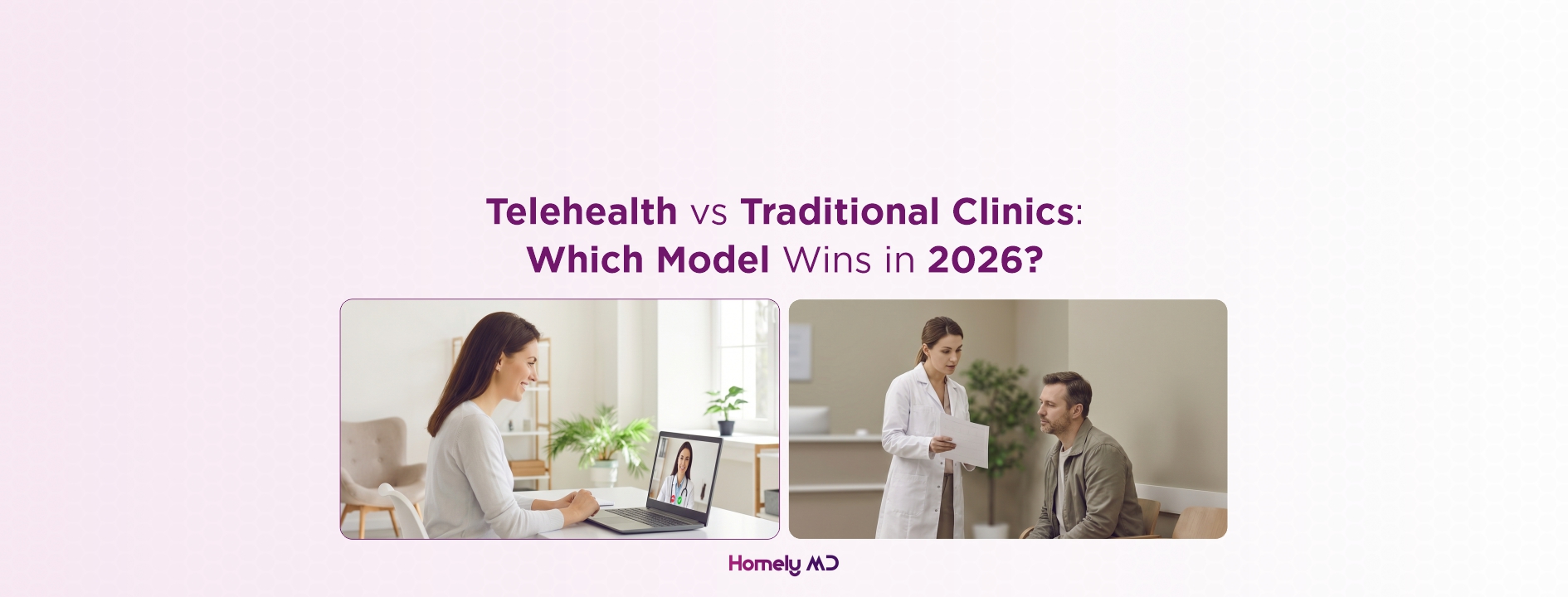
That’s where the comparison between telehealth and traditional clinics becomes real.
And by 2026, this is not just a debate. It’s a decision.
What traditional clinics still get right
Let’s be clear. Traditional clinics are not going anywhere.
There are things they still do well.
Physical examinations.
Procedures that require equipment.
Situations where in-person interaction is critical.
For certain cases, a clinic setup is necessary.
But the problem is not what clinics can do.
The problem is what they cannot adapt to.
Fixed location.
Limited hours.
Operational overhead.
And most importantly, dependence on clients physically showing up.
That’s where the friction begins.
What telehealth changes for providers
Now look at what a telehealth platform for providers brings to the table.
It removes location as a limitation.
You are no longer restricted to one area.
You are no longer dependent on footfall.
You are no longer bound to fixed clinic hours.
You can consult, follow up, and manage care remotely.
And this is not just theory.
According to research from Yale School of Medicine, telehealth has been shown to deliver outcomes comparable to in-person care in multiple cases, including improving patient quality of life.
That’s the turning point.
Because once outcomes are comparable, the decision shifts to efficiency.
Clients are already choosing convenience
This is something many providers underestimate.
Clients have already moved ahead.
They are used to convenience in everything else.
Food, shopping, banking, communication.
Healthcare is catching up.
With virtual healthcare services, clients can:
- Book faster
- Avoid travel
- Get quicker consultations
- Stay consistent with follow-ups
And once they experience that, going back to traditional systems feels slower.
This is not a future trend. It’s current behavior.
The economics are shifting too
This is where things get practical.
Running a clinic comes with:
- Rent
- Staff
- Utilities
- Maintenance
- Equipment
All of this adds up.
A digital health platform reduces a large part of that burden.
You can operate with:
- Lower overhead
- More flexible scheduling
- Better time utilization
And that directly impacts profitability.
According to healthcare research, telehealth improves access, reduces unnecessary hospital visits, and increases efficiency across care delivery systems.
For a provider, that means more output with less friction.
But telehealth is not a complete replacement
This is where most comparisons go wrong.
It’s not about choosing one and rejecting the other.
It’s about understanding where each model fits.
Telehealth works best for:
- Consultations
- Follow-ups
- Chronic care management
- Initial assessments
- Wellness and lifestyle guidance
Traditional clinics are still needed for:
- Physical procedures
- Diagnostics requiring equipment
- Emergency care
So the real question is not “which one wins completely”
It’s “which one helps you grow better”
The real advantage is hybrid flexibility
The providers who are winning right now are not choosing one model.
They are combining both.
They use a telehealth platform for providers to:
- Expand reach
- Handle consultations efficiently
- Maintain client continuity
And they use clinics only where necessary.
This hybrid approach allows:
- Better time management
- Higher patient volume
- Improved client experience
And most importantly, it removes dependency on a single system.
What this means for your practice in 2026
If you look ahead, a few things are becoming clear.
Clients will expect flexibility.
Digital interaction will be normal.
Access will matter more than location.
If your practice is built only around a physical clinic, you are limiting your growth.
Not because clinics are outdated.
But because clients are evolving faster than the model.
The hidden problem with staying traditional
This is something most providers don’t realize until later.
When you depend only on a clinic:
- Your growth is tied to one location
- Your schedule becomes rigid
- Your scalability becomes expensive
And over time, that starts to slow you down.
Meanwhile, providers using virtual healthcare services are:
- Reaching more clients
- Offering faster access
- Building stronger continuity
That gap keeps increasing.
Why telehealth is becoming a growth lever
Telehealth is not just a convenience feature anymore.
It is becoming a growth strategy.
It allows you to:
- See more clients in less time
- Reduce no-shows
- Improve follow-up consistency
- Build a wider client base
And most importantly, it gives you control over how you want to work.
That control is what many providers are looking for today.
Where Homely MD fits into this shift
This is exactly where HomelyMD becomes relevant.
It is not just about offering tools.
It’s about enabling providers to move into this model without figuring everything out themselves.
With HomelyMD, you are not starting from scratch.
You get access to:
- A structured digital health platform
- A system designed for both at-home and virtual care
- Clients already looking for flexible healthcare options
It allows you to step into telehealth and at-home care without losing the benefits of traditional practice.
So which model actually wins?
If you’re looking for a simple answer, here it is.
Telehealth does not replace clinics.
But it expands what you can do as a provider.
And in 2026, expansion is what matters.
The providers who adapt will grow.
The ones who stay fixed will feel the pressure.
What This Means Going Forward
This shift is already happening.
The question is not whether telehealth will become standard.
The question is whether your practice is ready for it.
Because once clients experience faster, more flexible care, they rarely go back.
And platforms that enable virtual healthcare services are making that transition easier than ever.
If you’re looking to expand your practice and adapt to how healthcare is evolving, get in touch today!
FAQs
1. Is telehealth replacing traditional clinics completely?
No, it’s more about adding flexibility. Clinics are still needed, but telehealth helps cover a large part of care more efficiently.
2. Why are providers shifting to telehealth platforms?
Mostly because it gives them more flexibility, better reach, and reduces the limitations of a fixed clinic setup.
3. Are virtual healthcare services reliable?
Yes, especially for consultations and follow-ups. In many cases, the outcomes are similar to in-person care.
4. Does telehealth actually help in growing a practice?
It can, because you’re not limited by location and can see more clients without increasing operational costs.
5. What is the best approach going forward?
A mix of both usually works best. Using telehealth for flexibility and clinics for procedures gives you the most balanced setup.